Ramadan is one of the twelve Arabic months. It is a month which is venerated in the Islamic religion, and it is distinguished from the other months by a number of characteristics and virtues, including the following:
1) Allah has made fasting this month the fourth pillar of Islam, as He says:
“The month of Ramadan in which was revealed the Quran, a guidance for mankind and clear proofs for the guidance and the criterion (between right and wrong). So whoever of you sights (the crescent on the first night of) the month (of Ramadan i.e. is present at his home), he must observe Sawm (fasts) that month…”
[al-Baqarah 2:185]
and it was narrated in al-Saheehayn (al-Bukhaari, 8; Muslim, 16) from the hadith of Ibn ‘Umar that the Prophet (peace and blessings of Allah be upon him) said: “Islam is built on five (pillars): the testimony that there is no god except Allah and that Muhammad is the Messenger of Allah; establishing prayer; paying zakat; fasting Ramadan; and Hajj to the House (the Kabah).”
2) Allah revealed the Quran in this month, as He says in the verse quoted above:
“The month of Ramadan in which was revealed the Quran, a guidance for mankind and clear proofs for the guidance and the criterion (between right and wrong)…”
[al-Baqarah 2:185]
And Allah says:
“Verily, We have sent it (this Quran) down in the Night of Al-Qadr (Decree).”
[al-Qadr 97:1]

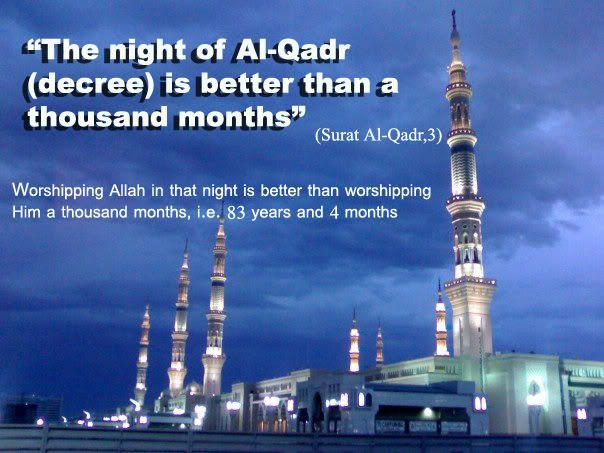
3) Allah has made Laylat al-Qadr in this month, which is better than a thousand months, as Allah says:
“Verily, We have sent it (this Quran) down in the Night of Al-Qadr (Decree).
And what will make you know what the Night of Al-Qadr (Decree) is?
The Night of Al-Qadr (Decree) is better than a thousand months (i.e. worshiping Allah in that night is better than worshiping Him a thousand months, i.e. 83 years and 4 months).
Therein descend the angels and the Rooh [Jibreel (Gabriel)] by Allaah’s Permission with all Decrees,
(All that night), there is peace (and goodness from Allaah to His believing slaves) until the appearance of dawn”
[al-Qadar 97:1-5]
“We sent it (this Quran) down on a blessed night [(i.e. the Night of Al-Qadr) in the month of Ramadan — the 9th month of the Islamic calendar]. Verily, We are ever warning [mankind that Our Torment will reach those who disbelieve in Our Oneness of Lordship and in Our Oneness of worship]”
[al-Dukhaan 44:3]
Allah has blessed Ramadan with Laylat al-Qadr. Explaining the great status of this blessed night, Surat al-Qadr was revealed, and there are many a hadith which also speak of that, such as the hadith of Abu Hurayrah (may Allah be pleased with him) who said: The Messenger of Allah (peace and blessings of Allah be upon him) said: “There has come to you Ramadan, a blessed month which Allah has enjoined you to fast, during which the gates of heaven are opened and the gates of Hell are closed, and the rebellious devils are chained up. In it there is a night which is better than a thousand months, and whoever is deprived of its goodness is indeed deprived.”
Narrated by al-Nasaa’i, 2106; Ahmad, 8769. classed as saheeh by al-Albaani in Saheeh al-Targheeb, 999.
And Abu Hurayrah (may Allah be pleased with him) said: The Messenger of Allah (peace and blessings of Allah be upon him) said: “Whoever spends Laylat al-Qadr in prayer out of faith and in the hope of reward, will be forgiven his previous sins.” Narrated by al-Bukhari, 1910; Muslim, 760.

4) Allah has made fasting Ramadan and spending its nights in prayer out of faith and in the hope of reward a means of forgiveness of sins, as was proven in al-Saheehayn (al-Bukhaari, 2014; Muslim, 760) from the hadith of Abu Hurayrah according to which the Prophet (peace and blessings of Allah be upon him) said: “Whoever fasts Ramadan out of faith and in the hope of reward, his previous sins will be forgiven.” And al-Bukhaari (2008) and Muslim (174) also narrated from Abu Hurayrah that the Prophet (peace and blessings of Allah be upon him) said: “Whoever spends the nights of Ramadan in prayer out of faith and in the hope of reward, his previous sins will be forgiven.”
The Muslims are unanimously agreed that it is Sunnah to pray qiyaam at night in Ramadan. Al-Nawawi said that what is meant by praying qiyaam in Ramadan is to pray Taraweeh, i.e., one achieves what is meant by qiyaam by praying Taraaweeh.
5) In this month, Allah opens the gates of Paradise and closes the gates of Hell, and chains up the devils, as is stated in al-Saheehayn (al-Bukhaari, 1898; Muslim, 1079), from the hadith of Abu Hurayrah who said that the Messenger of Allah (peace and blessings of Allah be upon him) said: “When Ramadan comes, the gates of Paradise are opened and the gates of Hell are closed, and the devils are chained up.”
6) Every night Allah has people whom He redeems from the Fire. Imam Ahmad (5/256) narrated from the hadith of Abu Umaamah that the Prophet (peace and blessings of Allah be upon him) said: “At every breaking of the fast, Allah has people whom He redeems.” Al-Mundhiri said: there is nothing wrong with its isnaad; and it was classed as saheeh by al-Albaani in Saheeh al-Targheeb, 987.
Al-Bazzaar (Kashf 962) narrated that Abu Sa’eed said: The Messenger of Allaah (peace and blessings of Allah be upon him) said: “Allah has people whom He redeems every day and night – i.e., in Ramadan – and every Muslim every day and night has a prayer that is answered.”
7) Fasting Ramadan is a means of expiation for the sins committed since the previous Ramadan, so long as one avoids major sins. It was proven in Saheeh Muslim (233) that the Prophet (peace and blessings of Allah be upon him) said: “The five daily prayers, from one Jumu’ah to the next and from one Ramadan to the next are expiation for (sins committed) in between, so long as you avoid major sins.”
8) Fasting in Ramadan is equivalent to fasting ten months, as is indicated by the hadith in Saheeh Muslim (1164) narrated from Abu Ayyoob al-Ansaari: “Whoever fasts Ramadan then follows it with six days of Shawwaal, it will be like fasting for a lifetime.” Ahmad (21906) narrated that the Prophet (peace and blessings of Allah be upon him) said: “Whoever fasts Ramadan, a month is like ten months, and fasting six days after al-Fitr will complete the year.”
9) Whoever prays qiyaam in Ramadan with the imam until he finishes, it will be recorded for him that he spent the whole night in prayer, because of the report narrated by Abu Dawood (1370) and others from the hadith of Abu Dharr (may Allah be pleased with him) that the Messenger of Allah (peace and blessings of Allah be upon him) said: “Whoever prays qiyaam with the imam until he finishes, it will be recorded for him that he spent the whole night in prayer.” Classed as saheeh by al-Albaani in Salaat al-Taraaweeh, p. 15
10) ‘Umrah in Ramadan is equivalent to Hajj. Al-Bukhaari (1782) and Muslim (1256) narrated that Ibn ‘Abbaas said: The Messenger of Allah (peace and blessings of Allah be upon him) said to a woman among the Ansaar, “What kept you from doing Hajj with us?” She said, “We only had two camels that we used for bringing water.” So her husband and son had gone for Hajj on one camel, and he left the other for them to use for bringing water.” He said, “When Ramadan comes, go for ‘Umrah, for ‘Umrah in Ramadan is equivalent to Hajj.” According to a report narrated by Muslim, “… is equivalent to doing Hajj with me.”
11) It is Sunnah to observe i’tikaaf (retreat for the purpose of worship) in Ramadan, because the Prophet (peace and blessings of Allah be upon him) always did that, as it was narrated in the hadith of ‘Aa’ishah (may Allah be pleased with her) that the Prophet (peace and blessings of Allah be upon him) used to spend the last ten days of Ramadan in i’tikaaf until he passed away, then his wives observed i’tikaaf after him.” Narrated by al-Bukhaari, 1922; Muslim, 1172.

12) It is mustahabb in the sense of being strongly recommended in Ramadan to study the Quran together and to read it a great deal. You may study the Quran together by reciting it to someone else and by having someone else recite it to you. The evidence that this is mustahabb is the fact that Jibreel used to meet the Prophet (peace and blessings of Allah be upon him) every night in Ramadan and study the Quran with him. Narrated by al-Bukhaari, 6; Muslim, 2308.
Reading Quran is mustahabb in general, but more so in Ramadan.
13) It is mustahabb in Ramadan to offer iftar to those who are fasting, because of the hadith of Zayd ibn Khaalid al-Juhani (may Allah be pleased with him) who said: The Messenger of Allah (peace and blessings of Allah be upon him) said: “Whoever gives iftar to one who is fasting will have a reward like his, without that detracting from the fasting person’s reward in the slightest.” Narrated by al-Tirmidhi, 807; Ibn Maajah, 1746; classed as saheeh by al-Albaani in Saheeh al-Tirmidhi, 647. see question no: ( 12598 )
And Allah knows best.
Source: Islam Q&A