Showing posts with label Introduction to Ramadan. Show all posts

Thursday, July 28, 2011

Why is Ramadan So Important to Muslims?

Why is Ramadan So Important to Muslims?

Allah has preferred certain months over others, certain days over others and certain nights over others.

Allah has preferred the day of Jumu’ah amongst all the other days of the week. Even at the level of a single night. Allah prefers certain parts of it to others. For example, the performance of nawafil ibadah (supererogatory worship) in the last third of the night is more beloved to Allah than its performance in any other parts of the night.

In a similar vein, Allah has preferred the month of Ramadan over all other months. It is only the name of this month that is mentioned in the Qur’an. It is only in this month that mankind has been blessed with most of the favours of Allah. It is in this month that the Torah, Injil, Zabur and the Qur’an were all revealed. It is the only month in which Allah has gathered goodness, light and guidance that stretches from one part of the globe to the other.

Abu Hurayrah narrates that the Messenger of Allah said: “The month of Ramadan has come to you, a blessed month wherein Allah has made obligatory fasting, opened the doors of Paradise and closed the doors of Hell.” (Ahmad)

SM Hasan al-Banna

What Have You Done to Prepare for Ramadan?

Ramadan will be here in four to five days! Take a step back from whatever it is you are rushing to do - yes, that includes the so-important work deadline, studying for an upcoming exam, meeting your friends for an outing, shopping, watching tv and whatever else it may be that needs your attention.

Ramadan comes by only once in a year. Our worldly pursuits are just that - worldly. Some of these pursuits are indeed worthwhile - for instance, working hard, or studying to achieve one's optimum potential in this life. But these endeavors will be so much easier for us if we devote as much time to increasing our worship of our Creator, if only we would realize!

So don't use the lack of time as an excuse not to increase our acts of worship http://www.blogger.com/img/blank.gifduring Ramadan. Preparing for Ramadan before it begins is a good way to ensure that you will have a productive month, and that you will reap in all of this holy month's benefits.

We have compiled a list of articles within this blog that can help you prepare for Ramadan. Please take the time to read through them.

You have four to five days left - Come on, you can DO IT!

Ramadan Mubarak.

1) To get you started, peruse through these Basic Facts on Ramadan. Even if you are a born-Muslim, and think you know everything there is to know about your own religion, reading these simple facts will put you in a right frame of mind to receive the messages in the articles.

2) Have you ever asked yourself what was the reason why Muslims fast? Fasting is not a religious tradition invented by Muslims, nor is it a practice conducted solely by Muslims. Fasting has been a religious tradition in the prophetic traditions of Judaism and Christianity too. Fasting is supposed to bring one closer to God. Read this wonderful article on the philosophy behind fasting.

3) We are all very busy in our lives with many responsibilities to meet. We go to school, study, work, take care of the home and the family. While we desire to set time aside to prepare for Ramadan, it is often easier said than done. This article sets out tips to help you do just that and to overcome the lack of time complaint.

4) It is said that the month before Ramadan, that is, the month of Sha'ban, is a very important month. It is recommended that we begin preparing for Ramadan during the month of Sha'ban. It would not be good to enter Ramadan without preparations - we would be unduly tired, irritable from the lack of food, water and even sleep. Typically, takes a few days to adjust to the new routine. But with adequate preparation, we will not suffer, and instead able to enjoy the full benefit of Ramadan. This article shows you how to get prepared.

Friday, August 20, 2010

Fasting During Ramadan

The following is an article contribution by Tariq Hyder from India, who blogs at http://websnacker.blogspot.com. He shares with us his thoughts on a typical fasting day during Ramadan. Enjoy!

What a Typical Day during Ramadan Entails!


Picture yourself experiencing the humid heat of scorching summer without any chilled coolers to cool you off. Envision missing your daily breakfast, lunch and your favorite cup of coffee at 11 post noon daily for 30 full days. Imagine having to miss that fat five- star Sunday brunch that your friend has invited you for or envisage having to give up that free trip to Thailand. Imagine all these together and not lying, being good, honest to yourself and others around you and much, much more! Well, these are just some (and many) of the things Muslims around the world (including me) will be sacrificing the few weeks to observe the piously sacred month of Ramadan.

The ninth month of the Islamic lunar calendar year, Ramadan or Ramzan, is acknowledged as the month of fasting - a period that signifies a time to be still, a time to become aware spiritually and a time to submit to complete subservience to Allah through personal sacrifice. It is also the month in which the Holy Quran was sent down (from the heavens) to Man.

I have often been asked whether it is hard to desist from eating and drinking for a whole month, especially in summer. I’m surprised when I always find myself replying “no” - for through being raised as a Muslim, fasting inescapably becomes embedded in one, a part of one’s being. For those who’ve come into Islam, fasting is undoubtedly a trying experience at first, I’m sure. Though, as soon as you realize what the health and religious benefits are, together with the feeling of being united with Muslims worldwide experiencing exactly the same, it makes for a rather awe-inspiring feeling.

The most captivating part of fasting during the month of Ramadan is the self-denial from food, drink and any sexual activity (both mental and physical) – especially to those who’ve never experienced a fast before. Here I see it fitting to add that the abstaining applies only from the break of dawn until sunset. No food or drink is to pass the lips; nose etc. meaning that taking a sneak dip in the pool is also a taboo! Smoking is prohibited as well.

It gets a bit more intricate and demanding… other senses are also under commitment to fast. The eyes (from wandering to that which is considered to interfere with your spiritual upliftment); ears (from gossip etc); tongue (from lying, backbiting etc); and other limbs should also, with the complete objective of pleasing the Almighty, be restrained if the faster wants his/her fast to be accepted. And I can hear you ask why?

The above mentioned is fundamentally two of the three vital elements required for a fast to be worthy of full acceptance. The third element is preventing the heart and mind from dwelling on anything other than the remembrance and praise of Allah.

And with these three aspects of one’s being combined, it makes for a rather perfect recipe for divine cleanliness and leaves the door wide open to a path that can lead to a higher spiritual plane and an awareness of others’ suffering… for the hunger pangs will certainly make you think back to that homeless person, that sick child, that frail old woman and the countless destitutes and poor orphans who cant even get a proper meal a day.

Fasting has always, across the religious spectrum, been an accepted way of cleansing the body (and strengthening the spirit). And with the health-conscious mindset reigning supreme in this age, it is fast gaining momentum.

A fast can easily last up to approximately 12-14 hours – starting at about four in the morning and ending at around 6.30 in the evening. The fast usually starts as early as three thirty in the morning when you have to wake-up and eat well ( but not gorge) to help you fast for the day. After performing the morning prayers at around five, it’s almost impractical to squeeze in any more sleep. Chances are I won’t hear the alarm if I try to sleep again…yet, I do fall asleep at around 7 and I arrive late to work at ten.

As the day carries on, the air-conditioned confines of my office becomes my shelter. Energy levels slip steadily, a wave of drowsiness constantly distracts and the stomach is rumbling. Personally, I find that minus the next meal on my mind, it is quite astounding how empty the brain feels. What else to think about if I don’t have to decide where to go to eat during my lunch hour and my energy levels are too low to go shopping. You really have no option then but to become conscious of why you’re fasting – which then leads to the kind of divine consciousness you are supposed to dwell on anyway. It’s all really a sanctified chain reaction.

The fast ends at sunset, preferably broken with a sip of fruit juice or water, and dates – a natural and copiously rich source of sugar – and the evening prayer, in the hope that the fast will be accepted. Tradition comes under analysis again… those deep-fried mutton samosas, chicken cutlets and fish fingers can’t possibly be healthy when one is aiming to purify the body but actually most Muslims end up feasting everyday – both during the morning pre-fast and post break sessions. The final prayer of the day is performed at around 8.30 in the night followed by the special prayer for Ramadan, which takes a bit more time and requires one to go to mosque and perform it with your fellow Muslim neighborhood.

This is in a nutshell is a typical day in the life of a working, fasting Muslim man or woman during Ramadan. For the archetypal Muslim housewife or women with children, and the extended circle as is quite common in Muslim families, the burden is actually tenfold. Yet, you’ll be astonished at their strength and their unvarying juggle between the no-nonsense and divine. Okay, I got to go now. It’s almost three o’ clock again!


Healthy Eating Habits Tips During Ramadan
at the Ramadan Blog!


How to Fast Healthily During Ramadan

What to Avoid During Ramadan

Dates | Beneficial Things to Eat During Ramadan

Friday, August 13, 2010

Fasting in Ramadan

More than one billion Muslims around the world are fasting during the month of Ramadan. In 2010, Ramadan will be for 30 days beginning on August 11 (in most parts of the world).

If you are a non-Muslim and have wondered why so many Muslims fast from dawn to dusk for every day during the month of Ramadan, then do spend a few minutes watching this informational video that will help answer this question.

Additionally, the following reading materials might be beneficial for you:

Why Do Muslims Fast During Ramadan?

Basic Facts on Ramadan

Fasting in Ramadan


Wednesday, August 4, 2010

Preparing for Ramadan 2010

Preparing for Ramadan 2010: Video Series
Highlights of "The Fast of Ramadan" Talk by Imam Zaid Shakir and Imam Suhaib Webb


The month of Ramadan is the perfect opportunity for Muslims to repent and to make-up for slacking off on obligatory prayers. If Muslims were to fast, seek God and truly repent during Ramadan, God will pardon us for all of the sins we have committed.

The Quran was revealed to Prophet Muhammad during Ramadan, as were other religious revelations such as the Torah. As such, Ramadan is considered the month of guidance.

Fasting during Ramadan brings us closer to God in many ways. When we sleep less, and deny ourselves many things that have been halal (permissible) to us during other times such as eating and drinking during the day time, we increase our spiritual nature. With increased spirituality, it becomes easier for us to do the things during Ramadan that we struggle with at other times, such as reading the Quran or praying sunnah prayers. We do these things willingly during Ramadan.

Fasting is a requirement on all healthy Muslims, male and female past the age of puberty. We cannot pick and choose aspects of our religion that we like. Islam is about submitting to God - and fasting is an act of submission.

It was mentioned that balancing life's responsibilities during Ramadan can be difficult. For instance, pressures to study for exams, or to work. It is best not to neglect pursuit of spirituality (remembrance of God through reading the Quran or attending night sunnah prayers) because you are worried about life's responsibilities. Instead, work out a balance that is comfortable. If studying for exams, use the time spent on reading the Quran or attending night prayers as a needed break. You will find yourself less burdened, and refreshed to hit the books later when you need to.

Does Allah Pay My Paycheck?

Imam Webb related a story. During his youth, he used to work at a call center in the evenings. He would ask a Muslim brother to join him and friends for nightly prayers. But the friend would always decline to join them, preferring to continue putting more hours at the call center. But Imam Webb never failed to invite him along. One day out of exasperation, the friend said "Does Allah pay my paycheck?". The next day, this friend was fired from his job at the call center. This, despite his commitment to stay on at the job and not to join in for the night prayers.

So does Allah pay your paycheck? Definitely worth thinking deeply about it as you make your choices this Ramadan!

If you reject (Allah), Truly Allah has no need of you; but He likes not ingratitude from His servants: if you are grateful, He is pleased with you” (Qur'an 39 verse 7)


MeccaOne: The Fast of Ramadan & the Furious Shaitan / Pt I


MeccaOne: The Fast of Ramadan & the Furious Shaitan / Pt II


MeccaOne: The Fast of Ramadan & the Furious Shaitan / Pt III


Recommended: Articles on Preparing for Ramadan

Basic Facts on Ramadan

Setting Goals and Planning

Why do We Fast During Ramadan?

Reading the Quran During Ramadan

The Importance of the Month of Shaban

Fasting During Shaban

Video Series 1: Preparing for Ramadan

Video Series 2: Ramadan Advice by Sheikh Hamza Yusuf

Friday, July 23, 2010

Reading the Quran During Ramadan

Muslims Reciting the Quran During Ramadan

Muslims around the world will spend their Ramadan, not only fasting from dawn to dusk for a month, but many will also spend it reciting the Quran daily.

Majority of Muslims will attend nightly prayers called the Taraweeh, which are held at mosques. It is also possible to perform the Taraweeh prayers at home. Each night a section of the Quran (a juz: 1/30 of the Quran) will be recited during the Taraweeh prayers. By the end of the month, the entire Quran would have been recited. This prayer is performed after the last compulsory daily prayer of Isha'a.

It is not compulsory to attend the Taraweeh prayers, or to finish reciting all of the Quran during Ramadan. But there are multitude of benefits to be derived from it.

Benefits of Reading Quran

Reading Quran during Ramadan is one of the best and most virtuous of good deeds, because Ramadan is the month of the Quran. Allah says (interpretation of the meaning):

“The month of Ramadan in which was revealed the Quran, a guidance for mankind and clear proofs for the guidance and the criterion (between right and wrong)”
[al-Baqarah 2:185]

Jibreel used to come to the Prophet (peace and blessings of Allah be upon him) every night in Ramadan, and study the Quran with him. Narrated by al-Bukhari, 5; Muslim, 4268.

Al-Bukhari (4614) narrated from Abu Hurayrah (may Allah be pleased with him) that Jibreel used to review the Quran with the Prophet (peace and blessings of Allah be upon him) once each year, and in the year in which he died, he reviewed it with him twice. From this it may be understood that it is mustahab to read Quran a great deal and to study it during Ramadan.

In another hadith, A’ishah relates that the Prophet said:
Verily the one who recites the Qur’an beautifully, smoothly, and precisely, he will be in the company of the noble and obedient angels. And as for the one who recites with difficulty, stammering or stumbling through its verses, then he will have TWICE that reward.” [Al-Bukhari and Muslim]

If you require help in interpreting the Arabic in the Quran, we came across links that we recommend.

Recommended Audio Quran (with English translation):

http://www.alhudapk.com/audio-video/fahm-alquran-english/default.asp

http://www.quranexplorer.com/Quran/Default.aspx

http://www.quran.net/quran/transPickthalShakirAzhar.asp

http://tanzil.info

http://www.listen2quran.com/default.aspx

Sunday, July 18, 2010

Why Do Muslims Fast During Ramadan?

This is an often asked question by non-Muslims. Non-Muslims find it strange that Muslims fast for 30 days from dusk to dawn. Fasting means to abstain from food or from certain kinds of food voluntarily, as an observance of a holy day or as a token of grief, sorrow, or repentance. Many non-Muslims even claim that it is detrimental to one's health in practice fasting.

However, fasting is not a religious tradition invented by Muslims, nor is it a practice conducted solely by Muslims. Fasting has been a religious tradition in the prophetic traditions of Judaism and Christianity too. Fasting is supposed to bring one closer to God.

Fasting Prescribed in Other Religions
Excerpted by Dr. Bilal Philips
For example:

Hindu: Fasting in Sanskrit is called upavaasa.
Devout Hindus observe fasting on special occasions as a mark of respect to their personal gods or as a part of their penance. Most devout Indians fast regularly or on special occasions like festivals. On such days they do not eat at all, eat once or make do with fruits or a special diet of simple food.

Jewish Jewish: Yom Kippur ("Day of Atonement") is the last of the Ten Days of Repentance observed on the 10th of Tishri. On that day, it is forbidden to eat, drink, wash, wear leather, or have sexual relations. In addition, prohibitions on labor similar to those on the Sabbath are in force. It should also be noted that Moses (peace be upon him) is recorded in the Torah to have fasted: "And he was there with the Lord 40 days and 40 nights, he neither ate bread not drank water." (Exodus 34:28)


For Catholics Christians, Lent is the major season of fasting, imitative of the forty-day fast of Jesus (peace be upon him). In the fourth century it was observed as six weeks of fasting before Easter or before Holy Week. It was adjusted to forty days of actual fasting in most places in the seventh century. Jesus (peace be upon him) is recorded in the Gospels to have fasted like Moses. "And he fasted 40 days and 40 nights, and afterward he was hungry." (Matthew 4:2 & Luke 4:2)

Quranic Verses on Ramadan

O you who believe! Observing the fasting is prescribed for you as it was prescribed for those before you, that you may become the pious (God-conscious).
(Qur’an al-Baqarah 2:183)

In the month of Ramadan the Qur'an was revealed, a book of guidance with proofs of guidance distinguishing right from wrong. Therefore whoever of you is present in that month let him fast. But who is ill or on a journey shall fast a similar number of days later on. Allah desires your well-being, not your discomfort. He desires you to fast the whole month so that you may magnify Him and render thanks to Him for giving you His guidance.
(Qur’an al-Baqarah 2:185)

As can be seen from the Quranic verses above, fasting is supposed to bring one closer to God. Fasting makes us aware of God.

Dr. Bilal Philips writes about the different levels of fasting. For fasting to be effective one should attain of the levels. Fasting is not simply abstaining from food and drink from dusk to dawn, and he explains why below.

The Levels of Fasting

There are as many levels of fasting as there are facets to being human. Proper fasting should encompass all dimensions of human existence for it to have the divinely intended effect.

The following are some of the major levels of fasting:

Ritual Level:

This level of fasting requires that the basic rules for fasting be fulfilled, which are avoiding food, drink and sexual intercourse between dawn and sunset for 29 or 30 days each year. On this level, one is basically following the letter of the laws regarding fasting without particular consideration for the spirit of fasting.
It is the entrance level which must be fulfilled for the fast to be Islamically correct, but the other levels must be added for the fast to have any real impact on the fasting person. Fasting on this level alone will not benefit one spiritually, except from the perspective of submission to divine instructions, if one chooses to follow the ritual consciously and not merely according to tradition. Thus, by itself, the ritual level will not purify one of sin or atone for sin.

The Physical Level:

Fasting on the "physical" level causes the fasting person to experience the pangs of hunger and thirst – when the prophetic (Sunnah) way of fasting is observed. Prophet Muhammad (peace be upon him) used to consume a very light meal before the dawn (suhur) and moderate meal (iftar) to break the fast at sunset, while scrupulously avoiding filling his stomach.

He is reported to have said, "The worst container a human being can fill is his stomach. A few morsels of food to keep a person's back straight are sufficient.
However, if his desire overcomes him, then let him eat a third, drink a third and leave a third for breathing."

The Prophet (peace be upon him) used to break his fast with a few fresh or dried dates and a glass of water just before beginning the sunset prayer.

This level allows the fasting person to experience the pangs of hunger and thirst and thereby develops sympathy in him or her for those starving and dying of thirst in other parts of the world.

Medical Benefits:

On the physical level, some chemicals in the brain that transmit messages and create feelings, called neurotransmitters, are affected by fasting. Fasting encourages the endorphin neurotransmitter system, related to the feeling of well being – and euphoria, to produce more endorphins and, in fact, makes us ‘feel' better. This is similar to the effect of exercise (but without the physical work).

It has also been noted by medical experts that fasting improves the physical health in numerous ways. For example, during the fast the body uses up stored cholesterol (fat) that is often deposited in the blood system, as well as in other fatty areas of the body. So, we find it does help keep the body firm and minimizes the danger of heart attacks.

The difference between the ritual level 1 and the physical level 2 is, a person doing only ritual fasting may eat large meals prior to beginning the fast and immediately upon ending the fast, and not feel any hunger or thirst throughout the whole month.

However, like level one, if the fasting person does not incorporate the other levels of fasting, the fast will only be physically exhausting.

The Prophet (peace be upon him) said, "Maybe a fasting person will gain nothing but hunger and thirst from fasting."

The Libidinal Level:

The sexual instinct and drives (libido) are harnessed on this level of fasting.

In these times where the media continually plays on sexual desires to promote and sell products, the ability to control these powerful desires is a plus.

Fasting physically reduces sexual desires and the fact that the fasting person has to avoid anything which could stimulate him psychologically helps to further lower the libido.

Prophet Muhammad (peace be upon him) said, "O youths, whoever among you is able to marry let him do so, for it restrains the eyes and protects the private parts. He who is unable to marry should fast, because it is a shield."

By restraining from sexual acts, even though they are permissible, the fasting people make it easier for themselves to restrain from forbidden sexual acts when they are not fasting.

The Emotional Level:

Fasting on this level involves controlling the many negative emotions which simmer in the human mind and soul. For example, among the most destructive emotions is anger. Fasting helps to bring this emotion under control.

Prophet Muhammad (peace be upon him) said:
"When one of you is fasting, he should abstain from indecent acts and unnecessary talk, and if someone begins an obscene conversation or tries to pick an argument, he should simply tell him, "I am fasting."

So, on this level, whatever negative emotions challenge the fasting person must be avoided.

A person has to abstain from lewd conversation and heated arguments. Even when one is in the right, it is better to let that right go and keep one's emotional fast intact.

Likewise, the negative emotion of jealousy is reduced, as every fasting person is reduced to the common denominator of abstinence; no one is externally superior to another in this regard.

The Psychological Level:

This level helps the fasting person psychologically to control evil thoughts and trains him or her, to some degree, how to overcome stinginess and greed.

The Prophet (peace be upon him) said,
"Allah has no need for the hunger and the thirst of the person who does not restrain himself from telling lies and acting on them even while observing the fast." [11]

In this age of immediate gratification, when the things of the world are used to fulfill human needs and desires almost as soon as they have them – the ability to delay gratification is an important skill.

What is between immediate gratification and delayed gratification is patience. During the fast, the believers learn patience – and the benefits of it.

From a psychological perspective, it is good to be somewhat detached from the things of the world.

There is nothing wrong with enjoying a good and full life – in fact, one can and should expect that.

However, it is important that people are able to detach ourselves from material things so that they do not become the most important part of their lives.

Fasting gives one the opportunity to overcome the many addictions which have become a major part of modern life.

Food, for many people, provides comfort and joy - and the ability to separate oneself from it gives the fasting people the psychological benefit of knowing that they do have some degree of control over what they do and what they do not do.

The Spiritual Level:


In order to establish this, the highest and most important level of fasting, the level of God-consciousness, Prophet Muhammad (peace be upon him) made the renewal of the intention for fasting a requirement before every day of fasting.

He was reported to have said, "Whoever does not intend to fast before Fajr (the dawn) will have no fast.

The daily renewal of intention helps to establish a spiritual foundation of sincerity essential for the spiritual cleansing effects of fasting to operate.

Sincere fasting purifies and atones for sin, as the Prophet (peace be upon him) said, "Whoever fasts Ramadan out of sincere faith and seeking his reward from God, his previous sins will be forgiven."

He was also reported to have said, "From one Ramadan to the next is atonement for the sins between them."

Sincere fasting brings one closer to Allah and earns a special reward.

The Prophet (peace be upon him) informed that there is a gate in paradise called Rayyan reserved for those who fast and he also said, "When Ramadan comes, the gates of Paradise are open."

Fasting is primarily between the person and God, as no one can be sure that any person is actually fasting.

Because of this intimate aspect of fasting, Allah was quoted by the Prophet (peace be upon him) as saying, "Every act of Adam's descendants is for themselves, except fasting. It is meant for Me alone, and I alone will give the reward for it."

When combined with the previous levels of fasting, this level transforms a person from within.

It restores, revives and regenerates the fasting person's spirituality and radically modifies his or her personality and character.

These are the precious products of a heightened state of God-consciousness.

Source: Excerpts from Dr. Bilal Philips

Sunday, August 23, 2009

What to Avoid During Ramadan

We came across this excellent article via an email forward recently. The following article contains useful reminders on what NOT to do during Ramadan - a valuable read indeed. The holy month of Ramadan will be over before we even realise it - so while we have the time, we should make good use of it by spending more time on our spiritual objectives. Ramadan only come once a year - seize the opportunity to reap in good for yourself and your family while it lasts.

1. Taking Ramadaan as a ritual: For many of us Ramadaan has lost its spirituality and has become more of a ritual than a form of Ibaadah. We fast from morning to night like a zombie just because everyone around us is fasting too. We forget that its a time to purify our hearts and our souls from all evil. We forget to make dua, forget to beseech Allaah to forgive us and ask Him to save us from the Fire. Sure we stay away from food and drink but that's about all.

Although the Prophet (Sal Allaahu Alaiyhi wa Sallam) said: "Jibreel said to me, 'May Allaah rub his nose in the dust, that person to who Ramadaan comes and his sins are not forgiven,' and I said, 'Ameen'. Then he said, 'May Allaah rub his nose in the dust, that person who lives to see his parents grow old, one or both of them, but he does not enter Paradise (by not serving them) and I said, 'Ameen'. Then he said, 'May Allaah rub his nose in the dust, that person in whose presence you are mentioned and he does not send blessings upon you,' and I said, 'Ameen.'" (Tirmidhi)

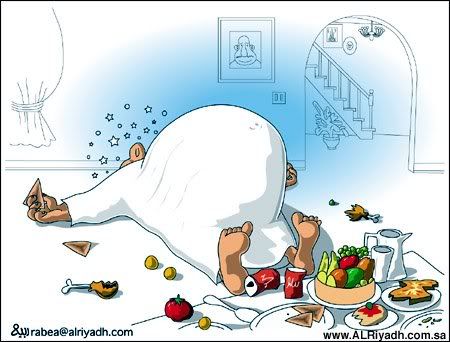
2. Too much stress on food and drink: For some people, the entire month of Ramadaan revolves around food. They spend the ENTIRE day planning, cooking, shopping and thinking about only food, instead of concentrating on Salaah, Quraan and other acts of worship. All they can think of is FOOD. So much so that they turn the month of 'fasting' into the month of 'feasting'. Come Iftaar time, their table is a sight to see, with the multitudes and varieties of food, sweets and drinks. They are missing the very purpose of fasting, and thus, increase in their greed and desires instead of learning to control them. It is also a kind of waste & extravagance.

".....and eat and drink but waste not by extravagance, certainly He (Allaah) likes not Al-Musrifoon (those who waste by extravagance)" [al-Araaf :31]

3. Spending all day cooking: Some of the sisters (either by their own choice or forced by their husbands) are cooking ALL day and ALL night, so that by the end of the day, they are too tired to even pray Ishaa, let alone pray Taraweeh or Tahajjud or even read Quraan. This is the month of mercy and forgiveness. So turn off that stove and turn on your Imaan!

4. Eating too much: Some people stuff themselves at Suhoor until they are ready to burst, because they think this is the way to not feel hungry during the day and some people eat at Iftaar, like there is no tomorrow, trying to 'make up for the food missed.' However, this is completely against the Sunnah. Moderation is the key to everything.

The Prophet (Sal Allaahu Alaiyhi wa Sallam) said: "The son of Adam does not fill any vessel worse than his stomach; for the son of Adam a few mouthfuls are sufficient to keep his back straight. If you must fill it, then one-third for food, one-third for drink and one-third for air." (Tirmidhi).

Too much food distracts a person from many deeds of obedience and worship, makes him lazy and also makes the heart heedless.

It was said to Imam Ahmad: Does a man find any softness and humility in his heart when he is full? He said, I do not think so.

5. Sleeping all day: Some people spend their entire day (or a major part of it) 'sleeping away their fast'. Is this what is really required of us during this noble month? These people also are missing the purpose of fasting and are slaves to their desires of comfort and ease. They cannot 'bear' to be awake and face a little hunger or exert a little self-control. For a fasting person to spend most of the day asleep is nothing but, negligence on his part.

6. Wasting time: The month of Ramadaan is a precious, precious time, so much so that Allaah calls this month "Ayyamum Ma'doodaat" (A fixed number of days). Before we know it, this month of mercy and forgiveness will be over. We should try and spend every moment possible in the worship of Allaah so that we can make the most of this blessing. However, there are some of us who waste away their day playing video games, or worse still, watching TV, movies or even listening to music. Subhaan Allaah! Trying to obey Allaah by DISOBEYING him!

7. Fasting but not giving up evil: Some of us fast but do not give up lying, cursing, fighting, backbiting, etc. and some of us fast but do not give up cheating, stealing, dealing in haraam, buying lotto tickets, selling alcohol, fornication, etc. and all kinds of impermissible things without realizing that the purpose of fasting is to not stay away from food and drink; rather the aim behind it is to fear Allaah.

"O you who believe! Fasting is prescribed for you as it was prescribed for those before you, that you may become Al-Muttaqoon (the pious)" [al-Baqarah 2:183]

The Prophet (Sal Allaahu Alaiyhi wa Sallam) said: "Whoever does not give up false speech and acting upon it, and ignorance, Allaah has no need of him giving up his food and drink." (Bukhaari)

8. Skipping Suhoor: The Prophet (Sal Allaahu Alaiyhi wa Sallam) said: "Eat suhoor for in suhoor there is blessing."(Bukhaari, Muslim).

And he (Sal Allaahu Alaiyhi wa Sallam) said: "The thing that differentiates between our fasting and the fasting of the People of the Book is eating suhoor." (Muslim)

9. Not fasting if they missed Suhoor: Some people are too scared to fast if they miss Suhoor. However, this is a kind of cowardice and love of ease. What is the big deal if you missed a few morsels of food? It's not like you will die. Remember, obedience to Allaah overcomes everything.

10. Delaying breaking fast: Some people wait until the adhaan finishes or even several minutes after that, just to be 'on the safe side'. However, the Sunnah is to hasten to break the fast, which means breaking fast whenever the adhaan starts, right after the sun has set. Aa'ishah (RA) said: This is what the Messenger of Allaah (Sal Allaahu Alaiyhi wa Sallam) used to do. (Muslim)

The Prophet (Sal Allaahu Alaiyhi wa Sallam) said: "The people will continue to do well so long as they hasten to break the fast." (Bukhaari, Muslim)

Determine to the best of your ability, the accuracy of your clock, calendar, etc. and then have tawakkul on Allaah and break your fast exactly on time.

11. Eating continuously until the time for Maghrib is up: Some people put so much food in their plates when breaking their fast and continue eating, enjoying dessert, drinking tea, etc., until they miss Maghrib. That is obviously not right. The Sunnah of the Prophet (pbuh) was that once he broke his fast with some dates, them he would hasten to the prayer. Once you are done with the prayer, you can always go back and eat some more if you wish.

12.Missing the golden chance of having your Dua accepted: The prayer of the fasting person is guaranteed to be accepted at the time of breaking fast.

The Prophet (Sal Allaahu Alaiyhi wa Sallam) said: "Three prayers are not rejected: the prayer of a father, the prayer of a fasting person, and the prayer of a traveler." (Tirmidhi).

Instead of sitting down and making Dua at this precious time, some people forego this beautiful chance, and are too busy frying samosas, talking, setting the food, filling their plates and glasses, etc. Think about it....Is food more important than the chance to have your sins forgiven or the fulfillment of your Duas.

13. Fasting but not praying : The fasting of one who does not pray WILL NOT BE ACCEPTED. This is because not praying constitutes kufr as the Prophet (Sal Allaahu Alaiyhi wa Sallam) said: "Between a man and shirk and kufr there stands his giving up prayer." (Muslim)

In fact, NONE of his good deeds will be accepted; rather, they are all annulled.

"Whoever does not pray 'Asr, his good deeds will be annulled." (Bukhaari)

14. Not fasting because of exams or work: Exams or work is NOT one of the excuses allowed by the Shariah to not fast. You can do your studying and revision at night if it is too hard to do that during the day. Also remember that pleasing and obeying Allaah is much more important than 'good grades'. Besides, if you will fulfil your obligation to fast, even if you have to study, Allaah will make it easy for you and help you in everything you do.

"Whosoever fears Allah, He will appoint for him a way out and provide for him from where he does not expect, Allah is Sufficient for whosoever puts his trust in Him." (Surah at-Talaaq 2-3)

15. Mixing fasting and dieting: DO NOT make the mistake of fasting with the intention to diet. That is one of the biggest mistakes some of us make (esp. sisters). Fasting is an act of worship and can only be for the sake of Allah alone. Otherwise, mixing it with the intention of dieting may become a form of (minor) Shirk.

16. Wasting the last part of Ramadaan preparing for Eid: Some people waste the entire last 10 days of Ramadaan preparing for Eid, shopping and frequenting malls, etc. neglecting Ibadah and Lailatul Qadr. although, the Prophet (Sal Allaahu Alaiyhi wa Sallam) used to strive the hardest during the last ten days of Ramadaan in worship (Ahmad, Muslim) and not in shopping. Buy whatever you need for Eid before Ramadaan so that you can utilize the time in Ramadaan to the max.

Aa'ishah (RA) said: "When the (last) ten nights began, the Messenger of Allaah (Sal Allaahu Alaiyhi wa Sallam)) would tighten his waist-wrapper (i.e., strive hard in worship or refrain from intimacy with his wives), stay awake at night and wake his family." (Bukhaari and Muslim).

17. Iftaar parties: Although inviting each other for breaking fast is something good and encouraged, some people go to extremes with lavish 'Iftaar parties' with all sorts of disobedience to Allaah, from flirting, mixing of the sexes and hijaab-less women, to show-off and extravagance, to heedlessness to Salaah, and Taraweeh to even music and dancing.

Wednesday, August 19, 2009

Preparing for Ramadan 2009: Video Lectures in English

Ramadan Mubarak Ramadan Kareem 2009!


In the continuing series on how to prepare to meet the challenges and reap the benefits of Ramadan 2009 (scroll below for links to more articles in the series), we have found a series of lectures by Sheikh Yasir Qadhi. He talks about a series of topics: why Muslims fast during Ramadan; why Ramadan is considered the most holy month in the Muslim calendar; what benefits Muslims gain by fasting; how we can better ourselves during this month; what are the minimum requirements asked of us during Ramadan, are just some of the topics addressed.

One of the interesting things he mentioned is that the gates of hell and Shaytan will be chained up during Ramadan. On other occasions, when we sin and we recognize that we have sinned, we tell ourselves that it is not we have who willingly sinned. Rather it was Shaytan who caused us to sin. In actuality, Shaytan only tempts us, or gives us suggestions, but it we who acts. But during Ramadan we have absolutely no excuse. Whatever sins we commit, we do it of our own accord. It is all us! So be wary of what we do during Ramadan. If we lose our temper, it is not Shaytan who has made us that way. It is doing of our own accord.

Allah's apostle said "When the month of Ramadan starts, the gates of the heaven are opened and the gates of hell and the devils are chained" [Bukhari]

The series of Ramadan lectures by Sheikh Yasir Qadhi is highly recommended. Well worth the time spent listening to it.


Part 1


Part 2


Part 3


Part 4


Part 5


Part 6


Part 7


Part 8


Part 9


Part 10


Preparing for Ramadan 2009 Articles

Muslims Around the World Prepare for Ramadan 2009

Preparing for Ramadan 2009: The Importance of the Month of Shaban

Preparing for Ramadan 2009: Setting Goals and Planning


Enjoy Ramadan Tastes from Around the World
Here on the Ramadan Blog!


Ramadan Iftar Recipe from India

Ramadan Iftar Recipe from Singapore

Ramadan Iftar Recipes | Middle East Soups

Ramadan Iftar Recipe from Morocco

Ramadan Iftar Recipe from Saudi Arabia

More on Ramadan Iftar Recipes

Saturday, August 15, 2009

Preparing for Ramadan 2009: The Importance of the Month of Shaban

A Muslim woman reads a copy of the Koran at the Istiqlal mosque during the second day of ramadan in Jakarta, Indonesia, the world's most populous Muslim-majority country, on September 2, 2008. (ADEK BERRY/AFP/Getty Images)

It is said that the month before Ramadan, that is, the month of Sha'ban, is a very important month. It is recommended that we begin preparing for Ramadan during the month of Sha'ban.

We should make use of our time wisely during Sha'ban. Marathoners prepare for their marathon competition months ahead of the actual day. And we should similarly prepare for our month of fasting, prayer and reflection ahead of time. It would not be good to enter Ramadan without preparations - we would be unduly tired, irritable from the lack of food, water and even sleep. Typically, takes a few days to adjust to the new routine. But with adequate preparation, we will not suffer, and instead able to enjoy the full benefit of Ramadan.

If we have developed bad habits over the last year - for instance, waking up late in the mornings, then we should begin to change those habits before Ramadan, so that we are able to wake up for our morning food and the prayers.

The merits of fasting and doing good during Sha'ban are also plentiful.

An excerpt from a useful article on the benefits of fasting during Sha'ban by Mufti Taqi Usmaani is below:

Sha’ban is one of the meritorious months for which we find some particular instructions in the Sunnah of Prophet Muhammad, Sall-Allahu alayhi wa sallam. It is reported in the authentic ahadith that Prophet Muhammad, Sall-Allahu alayhi wa sallam, used to fast most of the month in Sha’ban. These fasts were not obligatory on him but Sha’ban is the month immediately preceding the month of Ramadan. Therefore, some preparatory measures are suggested by Prophet Muhammad, Sall-Allahu alayhi wa sallam. Some of these are given below:

1. The blessed companion Anas, Radi-Allahu anhu, reports that Prophet Muhammad, Sall-Allahu alayhi wa sallam, was asked, “Which fast is the most meritorious after the fasts of Ramadan?” He replied, “Fasts of Shaban in honor of Ramadan.”

2. The blessed companion Usama ibn Zaid, Radi-Allahu anhu, reports that he asked Prophet Muhammad, Sall-Allahu alayhi wa sallam: “Messenger of Allah, I have seen you fasting in the month of Sha’ban so frequently that I have never seen you fasting in any other month.” Prophet Muhammad, Sall-Allahu alayhi wa sallam, replied: “That (Sha’ban) is a month between Rajab and Ramadan which is neglected by many people. And it is a month in which an account of the deeds (of human beings) is presented before the Lord of the universe, so, I wish that my deeds be presented at a time when I am in a state of fasting.”

3. Ummul Mu’mineen ‘Aishah, Radi-Allahu anha, says, “Prophet Muhammad, Sall-Allahu alayhi wa sallam, used to fast the whole of Sha’ban. I said to him, ‘Messenger of Allah, is Sha’ban your most favorite month for fasting?’ He said, ‘In this month Allah prescribes the list of the persons dying this year. Therefore, I like that my death comes when I am in a state of fasting.”

4. In another Tradition she says, “Prophet Muhammad, Sall-Allahu alayhi wa sallam, would sometimes begin to fast continuously until we thought he would not stop fasting, and sometimes he used to stop fasting until we thought he would never fast. I never saw the Messenger of Allah, Sall-Allahu alayhi wa sallam, fasting a complete month, except the month of Ramadan, and I have never seen him fasting in a month more frequently than he did in Sha’ban.”

5. In another report she says, “I never saw the Messenger of Allah, Sall-Allahu alayhi wa sallam, fasting in a month so profusely as he did in the month of Sha’ban. He used to fast in that month leaving only a few days, rather, he used to fast almost the whole of the month.”

6. Ummul-Mu’mineen Umm Salamah, Radi-Allahu anha, says: “I have never seen the Messenger of Allah fasting for two months continuously except in the months of Sha’ban and Ramadan.”

These reports indicate that fasting in the month of Sha’ban, though not obligatory, is so meritorious that Prophet Muhammad, Sall-Allahu alayhi wa sallam, did not like to miss it.

But it should be kept in mind that the fasts of Sha’ban are for those persons only who are capable of keeping them without causing deficiency in the obligatory fasts of Ramadan. Therefore, if one fears that after fasting in Sha’ban, he will lose strength or freshness for the fasts of Ramadan and will not be able to fast in it with freshness, he should not fast in Sha’ban, because the fasts of Ramadan, being obligatory, are more important than the optional fasts of Sha’ban. That is why Prophet Muhammad, Sall-Allahu alayhi wa sallam, himself has forbidden the Muslims from fasting one or two days immediately before the commencement of Ramadan. The blessed Companion Abu Hurairah, Radi-Allahu anhu, reports Prophet Muhammad, Sall-Allahu alayhi wa sallam, to have said, “Do not fast after the first half of the month of Sha’ban is gone.”

According to another report Prophet Muhammad, Sall-Allahu alayhi wa sallam has said: “Do not precede the month of Ramadan with one or two fasts.”

The essence of the above-quoted ahadith is that Prophet Muhammad, Sall-Allahu alayhi wa sallam, himself used to fast most of the month of Sha’ban, because he had no fear of developing weakness or weariness before the commencement of Ramadan. As for others, he ordered them not to fast after the 15th of Sha’ban for the fear that they would lose their strength and freshness before Ramadan starts, and would not be able to welcome the month of Ramadan with enthusiasm. (Source: albalagh.net)


We also came across this short lecture by Sheikh Husain Abdul Sattar that reminds us of what our purpose should be for Ramadan.


Lecture on How to Prepare for Ramadan
During the Month of Sha'ban


Highlights of the Lecture
:

It is deplorable for any Muslim to enter and exit the month of Ramadan in the exact same state especially when Ramadan is the month when God showers his infinite mercy to all believers at this period. Muslims should be mindful to prioritize their time for spiritual activities and Islamic responsibilities over earthly pursuits. For instance, a news or tv buff would rush home to watch or read the news. And miss out on prayer. But the world will continue as it is whether you are up-to-date on the news or not. It is YOU that would miss out on your rewards if you choose to forgo prayer over catching the latest news.

NOTE: The editors of this blog are seeking input from readers. If you wish to share with us your Ramadan experience, or write us an article on a topic about Ramadan, for instance, how Ramadan is celebrated in your country, your Ramadan reflections and good deeds, or even your favorite iftar recipes, please send us an email at ramadanblog (at) gmail (DOT) com.

Wednesday, August 12, 2009

Basic Facts on Ramadan

Photo Source

The following are some basic FAQs on Ramadan that would be helpful to non-Muslims.

What does the word "Ramadan" mean?
Ramadan is the name of the ninth month of the Islamic calendar. The original meaning of the word was "scorching heat".

What is an Islamic calendar?
The Islamic calendar is a lunar calendar. This means that each month begins with the sighting of the new crescent moon. There are twelve months in the year. A lunar year is 354 days long. This is different from a solar calendar like the Gregorian calendar used in the West. The solar year lasts 365 days. Because the lunar year is shorter, each date on it falls about 10 or 11 days earlier, relative to the solar calendar, with each succeeding year.

Why do you say Ramadan is "predicted" to start on a certain date?
As I mentioned above, each month in the Islamic calendar starts with the sighting of the new crescent moon. Scientific calculations can pinpoint exactly when the astronomical new moon occurs, and can predict with some accuracy when the first crescent will be visible after this, but there are many factors that can complicate this, such as the weather. For this reason, and so that even ordinary Muslims who are not astronomers can take part, the rule is that the new crescent moon must be sighted by human observers. And we don't know exactly when it will appear until it's seen!

Does the month of Ramadan commemorate anything?
The month of Ramadan is when the first verses of the Quran were revealed. Note: The entire Quran was revealed over a period of about 23 years, starting in 610 CE and ending in 632 CE.

What is the purpose of the fast?
Quran Surah al-Baqarat verse 183 states that the purpose of the fast is to develop a quality called in Arabic "taqwa". Taqwa may be defined as, "Worshiping God as if you see Him because if you don't, He sees you." It is thus a kind of awe or God-fearingness, an awareness that God is always watching. Nobody but God and the person fasting know if that person actually observed the entire fast or secretly cheated. Thus, in order to resist the temptation to cheat, one has to remember that God is always watching and will see any lapse.

What does the fast entail?
The fast is from dawn to sunset each day of Ramadan. The fast involves refraining from food, drink, and (for married people) sexual relations during the daylight hours.

Who has to fast?
The fast is obligatory on all sexually mature adult Muslims. Those who are mentally handicapped or insane are not considered "adult" and do not have to fast. People who are ill do not have to fast if it would further damage their health; however, they should make up the missed fasts later when they become well again. Women who are pregnant or nursing are considered "ill" because fasting would harm their babies. As well, women who are having their menstrual period or who are experiencing post-partum bleeding should refrain from fasting during the days of their bleeding; the combination of blood loss and fasting could damage their health. Children who have not yet reached puberty are not required to fast. However, it is good for them to practice, and for this reason many Muslim children do fast starting from age seven or nine. A doctor should be consulted about how much fasting is safe for a growing child. People who are traveling may also break their fast if they feel that keeping it would harm them; as well, soldiers on guard duty for whom maximum readiness is a must may break their fast. In all cases of illness or fear of illness, the missed days need to be made up later.

Are there any other observances or customs attached to Ramadan?
The Muslim world has an almost staggering diversity of cultures and each Muslim country may have its own customs and rites associated with Ramadan.

Some customs that are observed by most Muslims include the following:
Recitation of the entire Quran, in imitation of the Prophet Muhammad (peace be upon him) who did so. This is usually done for the community from the mosques or (in Muslim countries) on the radio; individuals or families may also get together for their own recitation.

Observance of special night vigil prayers in the late evening or middle of the night called tarawih.

Withdrawing to the mosque during the last ten nights of Ramadan for prayer and Quran recitation, which is called itikaf meaning "seclusion".

Celebration of the "Night of Power" marking the specific date of the beginning of the revelation of the Quran on the 27th of Ramadan.

As well, the fast is broken each evening with a meal called "iftar" (meaning "breaking the fast"), and the last meal in the morning before dawn is called "suhur" (meaning "morning meal").

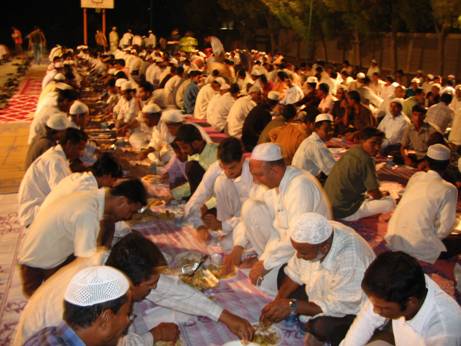
In Muslim countries it is quite common to have feasts that last all night and run from iftar to suhur. These feasts are a time of celebration and community. There is also a special holiday marking the end of Ramadan, called Eid al-Fitr.

What's Eid al-Fitr?
The name Eid al-Fitr means "feast of the fast-breaking". It takes place on the first day of the month that follows Ramadan. There is a special salat (prayer) which the whole community should come together for. As well, those who can afford to do it should provide a small amount of food for the needy so that everybody can celebrate. The value of this gift is about $15 today. Most communities have a variety of festive celebrations and meals to mark the day.

Information: Al-Muhajabah

Ramadan Mubarak 2009

Photo Source


Dear readers, Ramadan Mubarak and Ramadan Kareem 2009 to all of you.

Muslims all around the world are awaiting the start of Ramadan and are all busy preparing for it.

The editors of the Ramadan Blog welcomes you to the online site to celebrate the holy month of Ramadan.

The Ramadan Blog is the online source for all Muslims from around the world regardless of race and nationality to gather, reflect, learn and share our Ramadan experiences.

Non-Muslim readers are encouraged to read the articles and interact with Muslims through this online medium to learn more about the holy month of Ramadan and the Muslim experience. Peace be upon you.

In the United States, it was announced during last Friday's Jumah prayers that Ramadan would begin on August 22, 2009. In other countries, it has been said that Ramadan would begin on Augusy 21, 2009. Please refer to this site for up-to-date information on when Ramadan would start.

To learn why the exact date of Ramadan is uncertain, please refer to this article.

NOTE: The editors of this blog are seeking input from readers. If you wish to share with us your Ramadan experience, or write us an article on a topic about Ramadan, for instance, how Ramadan is celebrated in your country, your Ramadan reflections and good deeds, or even your favorite iftar recipes, please send us an email at ramadanblog (at) gmail (DOT) com.

Photo Source

Thursday, July 30, 2009

When is Ramadan 2009?

When Does Ramadan Begin in 2009?

Every ninth month of the Islamic calendar (lunar calendar), Muslims around the world fast (no food and water) from dawn to dusk for one month. Each day, Muslims will break their fast at sundown with special prayers at mosques. This practice serves to remind them to empathise with those less fortunate than themselves.

The Islamic months in the Islamic calendar are named as follows:

Muharram محرّم (or Muharram al Ḥaram)
Safar صفر (or Ṣafar al Muzaffar)
Rabi' al-awwal (Rabī' I) ربيع الأول
Rabi' al-thani (or Rabī' al Thānī, or Rabī' al-Akhir) (Rabī' II) ربيع الآخر أو ربيع الثاني
Jumada al-awwal (Jumādā I) جمادى الاول
Jumada al-thani (or Jumādā al-akhir) (Jumādā II) جمادى الآخر أو جمادى الثاني
Rajab رجب (or Rajab al Murajab)
Sha'aban شعبان (or Sha'abān al Moazam)
Ramadan رمضان (or Ramzān, long form: Ramaḍān al Mubarak)
Shawwal شوّال (or Shawwal al Mukarram)
Dhu al-Qi'dah ذو القعدة
Dhu al-Hijjah ذو الحجة

Of all the months in the Islamic calendar, Ramadan is the most venerated. Muslims are required to abstain from eating, drinking, smoking and sex during the daylight hours of this month.

Source: Wikipedia


It is estimated that Ramadan will start on August 21, 2009. This is subject to the first visual sighting of the lunar crescent.

Monday, September 1, 2008

The Ramadan Blog

It is time for Ramadan once again. People around the world will begin their month of fasting on September 1 or September 2 depending on the observation of the new moon.

A friend had a brilliant idea of creating a Ramadan Blog to detail our various thoughts and reflections during the month of Ramadan, which is considered a very important month for Muslims. It is time for Muslims to get closer to God.

Prophet Muhammad said, “Ramadan burns the sins and faults, just as the fire burns the wood.” The importance of this divine month was reiterated by the Prophet when he said, “The Month of Ramadan is the month of Allah (God), bringing His Mercy and Forgiveness.” According to the Holy Qur’an, fasting was made obligatory by God not only for the followers of the Prophet Muhammad but also for the followers of all the Prophets who preceded him (including prophets Moses and Jesus): “O you who believe! Fasting is prescribed for you, as it was prescribed for those who preceded you; that perhaps you will be mindful of God,” (Qur’an 2:183).

It is the aim of this blog to help us make this task easier for us by sharing our experiences here online.

The group of us are also from three different continents in the world, and while our religious practices are the same, some differ due to cultural differences. Namely, the food we eat during iftar! We plan to post some great pictures of Ramadan iftar as well. And we invite Muslim readers from all over to send us their own Ramadan iftar pictures.

Thank you for your visit. We hope you are inspired to do good during this month.