


At the historic site called Beamish, in County Durham, there is a gentleman's house recreated to the era of the 1820s. It's not very big or very impressive, but it has pretention. Part of that is mediocre but fashionable -- or maybe just past fashionable -- art in the form of engravings.
One of them is a single sheet illustrated and captioned recording the 18th century military careers of Belgrade and Clumsy. Belgrade was a widow (?) who continued to follow the British army after she lost her husband. The engraving celebrates her role in rescuing and caring for wounded soldiers.
Clumsy was her dog. And what a dog! At the battle of Dettlingen, as French and English armies faced each other, a dog emerged from the French lines and began to berate the English in dog fashion. Clumsy was having none of it. He went out, beat up the French dog, chased him away, and then calmly returned to the English lines.
The English went on to win the battle.
You can't make this stuff up. Well, I didn't. But just as I saw every modern re-creation and restoration at every historical site I visited in Britain, I can't help seeing Deeds of Arms everywhere.
Showing posts with label war and peace. Show all posts
Showing posts with label war and peace. Show all posts
Wednesday, July 20, 2011

Heavy armor
A BBC article on the weight of armor has got just about all my Facebook friends chattering.
Some of the professional historians think this is "pope is Catholic" junk science, and ask why in this time of disappearing funding for scholarly history, need this money be spent in this way? And were any historians consulted anyway?
Some of the reenactors are more interested, but the more informed -- the ones who have both worn armor and studied actual warfare -- ask whether this was a well-designed experiment.
I am both a professional scholar and someone who has worn armor (for 4 decades if you can believe it!) and I am not overly impressed -- tho I haven't seen the actual writeup behind the BBC article.
First, where are the horses? For much of the Middle Ages, it was the guys on horseback who were well-armed, and vice-versa.
Second, I say to the people who emphasize the drawbacks of armor what I say to those who are skeptical about the usefulness of heavy cavalry. Why did rich and important people buy expensive armor and wear it? and why did people who organized and paid for armies pay extra to well-armed men?
Third, full armor did have drawbacks and went out of use fairly quickly after it hit its peak of development. But the situation is not a binary one of full armor/no armor. Let's have a little more subtle analysis here.
Thursday, June 30, 2011
More on politics in the 21st century --gaming with Mossadegh's cat
Mossadegh was prime minister of Iran in the early 1950s, and his effort to gain control of Iran's oil led to a crucial crisis of modern Iranian history and of US-Iranian relations.
Two people at the University of Southern California thought Americans should know this crisis better -- and so they designed a game in which the player plays Mossadegh's cat.
You read it right.
This is a serious educational project, motivated in part by the desire to game conflict without focussing entirely on violence. You can find a link to the game and more on the project here.
Two people at the University of Southern California thought Americans should know this crisis better -- and so they designed a game in which the player plays Mossadegh's cat.
You read it right.
This is a serious educational project, motivated in part by the desire to game conflict without focussing entirely on violence. You can find a link to the game and more on the project here.
Thought for the 4th
From TomDispatch.com, on the non-withdrawal from Afghanistan:
Update: The more I think about this the more I realize that what I said once is literally true: the USA could have built a new world on Mars but settled instead for blowing up Iraq.
"It’s increasingly apparent that our disastrous wars are, as Chairman of the Senate Foreign Relations Committee John Kerry recently admitted, “unsustainable.” After all, just the cost of providing air conditioning to U.S. personnel in Iraq and Afghanistan -- $20 billion a year -- is more than NASA’s total budget."
Update: The more I think about this the more I realize that what I said once is literally true: the USA could have built a new world on Mars but settled instead for blowing up Iraq.
Tuesday, June 7, 2011
Talking about that other place
Peter Van Buren was a Provincial Reconstruction Team leader for the U.S. Department of State in Iraq, and he speaks with some authority when he says that the "diplomatic" presence in Iraq after the military withdrawal at the end of the year -- if that indeed happens -- will be in effect a continuing, and expensive, occupation. An excerpt from TomDispatch:
... the [State] Department has requested $6.3 billion for Iraq. Congress has yet to decide what to do. To put these figures in perspective, the State Department total operating budget for this year is only about $14 billion (the cost of running the place, absent the foreign aid money), so $6.3 billion for one more year in Iraq is a genuine chunk of change.Makes you think about the sheer role of inertia in human affairs...
How Does It End?
Which only leaves the question of why.
Pick your forum -- TomDispatch readers at a kegger, Fox news pundits following the Palin bus, high school students preparing to take SATs, unemployed factory workers in a food-stamp line -- and ask if any group of Americans (not living in official Washington) would conclude that Iraq was our most important foreign policy priority, and so deserving of our largest embassy with the largest staff and largest budget on the planet.
Does Iraq threaten U.S. security? Does it control a resource we demand? (Yes, it’s got lots of oil underground, but produces remarkably little of the stuff.) Is Iraq enmeshed in some international coalition we need to butter up? Any evil dictators or WMDs around? Does Iraq hold trillions in U.S. debt? Anything? Anyone? Bueller?
Eight disastrous years after we invaded, it is sad but altogether true that Iraq does not matter much in the end. It is a terrible thing that we poured 4,459 American lives and trillions of dollars into the war, and without irony oversaw the deaths of at least a hundred thousand, and probably hundreds of thousands, of Iraqis in the name of freedom. Yet we are left with only one argument for transferring our occupation duties from the Department of Defense to the Department of State: something vague about our “investment in blood and treasure.”
Think of this as the Vegas model of foreign policy: keep the suckers at the table throwing good money after bad. Leaving aside the idea that “blood and treasure” sounds like a line from Pirates of the Caribbean, one must ask: What accomplishment are we protecting?
The war’s initial aim was to stop those weapons of mass destruction from being used against us. There were none, so check that off the list. Then it was to get rid of Saddam. He was hanged in 2006, so cross off that one. A little late in the game we became preoccupied with ensuring an Iraq that was “free.” And we’ve had a bunch of elections and there is a government of sorts in place to prove it, so that one’s gotta go, too.
What follows won’t be “investment,” just more waste. The occupation of Iraq, centered around that engorged embassy, is now the equivalent of a self-licking ice cream cone, useful only to itself.
Changing the occupying force from an exhausted U.S. Army that labored away for years at a low-grade version of diplomacy (drinking endless cups of Iraqi tea) to a newly militarized Department of State will not free us from the cul-de-sac we find ourselves in. While nothing will erase the stain of the invasion, were we to really leave when we promised to leave, the U.S. might have a passing shot at launching a new narrative in a Middle East already on edge over the Arab Spring.
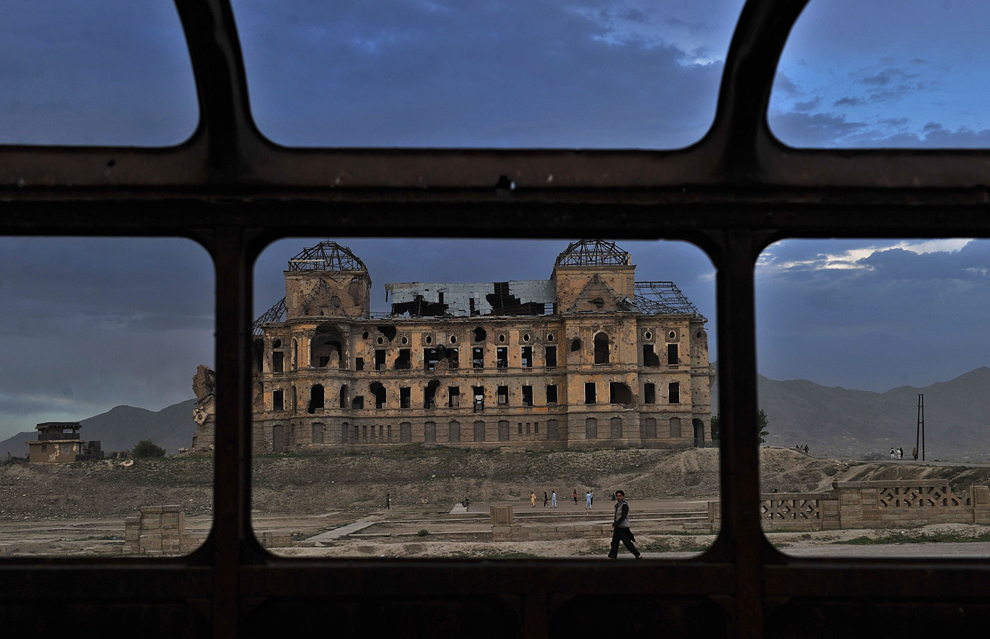
Image: The Baghdad embassy under construction. It is strikingly like an Abbasid palace.
Friday, June 3, 2011
Tuesday, May 31, 2011
Those belligerent jousters
In my own research on jousting which is based on Charny's questions on the law of arms as it applies to jousting tournaments and war, I got the impression that men at arms, full-fledged warriors, were a pretty argumentative lot. But of course, since Charny's questions are about resolving arguments, Charny had to conjure up some belligerent sorts, however many there may have been in real life. A few choice passages in Froissart's Chronicles convinced me that I was right about the belligerence, but I am pleased nonetheless to find in Noel Fallows' Jousting in Medieval and Renaissance Iberia proof positive that jousters were so concerned about their honor that they often got into arguments about the rules of the game and the rulings of the presiding judges.
One of the most interesting documents in Fallows' book is a very detailed account of a deed of arms that took place in 1434, El Passo Honroso de Suero Quinones. This deed, which involved ten jousters taking on all comers, was recorded blow-by-blow by a jouster, who not only gave a detailed account of each course, and explained which of the competitors did better, and why. I have my doubts that Froissart gave an accurate account in his famous description of St. Inglevert, but this account by Pero Rodriguez de Lena inspires confidence.
In the account it is quite common for there to be some accident that prevents two jousters from finishing the number of courses with broken spears set forth in the rules of the occasion, or some other event takes place that inspires one of the competitors to make a plea to the judges for a special dispensation – generally that they be allowed to ride some more courses on the field, perhaps at a later time. The judges, in this case two senior knights, absolutely refuse to change the rules or reverse their own decision once it has been made. To the demands of the competitors, the judges oppose the fact that all of the jousters have sworn to obey them in all matters. When the host of the event persists in defying them over a non-standard joust he wants to ride, they have him taken prisoner!
Yes, those old jousters were a willful lot, and those who presided over them had to push back hard.
One of the most interesting documents in Fallows' book is a very detailed account of a deed of arms that took place in 1434, El Passo Honroso de Suero Quinones. This deed, which involved ten jousters taking on all comers, was recorded blow-by-blow by a jouster, who not only gave a detailed account of each course, and explained which of the competitors did better, and why. I have my doubts that Froissart gave an accurate account in his famous description of St. Inglevert, but this account by Pero Rodriguez de Lena inspires confidence.
In the account it is quite common for there to be some accident that prevents two jousters from finishing the number of courses with broken spears set forth in the rules of the occasion, or some other event takes place that inspires one of the competitors to make a plea to the judges for a special dispensation – generally that they be allowed to ride some more courses on the field, perhaps at a later time. The judges, in this case two senior knights, absolutely refuse to change the rules or reverse their own decision once it has been made. To the demands of the competitors, the judges oppose the fact that all of the jousters have sworn to obey them in all matters. When the host of the event persists in defying them over a non-standard joust he wants to ride, they have him taken prisoner!
Yes, those old jousters were a willful lot, and those who presided over them had to push back hard.
Saturday, May 28, 2011
The quest for answers to Charny's Questions
I have just posted the current draft of my translation of Geoffroi de Charny’s Questions concerning the joust, tournaments, and war. It is in the form of a blog entitled Charny’s Questions and it is located at http://charnyqs.blogspot.com/.
I have made the questions available in hopes that other scholars will know of parallels to individual questions or even solutions to some of the legal problems raised by Charny. Indeed, I have found or been sent a few already, and will be putting them in the comment section of the appropriate question. If you have something relevant, please do likewise.
I must say that I am only interested in material that originates in primary sources or in a detailed discussion in secondary treatments (few and far between!). I learned a long time ago that it is quite easy to come up with a plausible answer to most of these questions, indeed more than one. As Charny said repeatedly, “there are many good reasons offered on either side.” It’s a fun game to spin your own answers, especially around a campfire at a medieval re-creation, drink in hand, but that’s not what the blog is for.
Anyone is welcome to read the translation -- which, I warn you, is not quite done and has a few irresolvable problems -- but it is copyrighted. Please do not publish; if you are a scholar you might even hesitate to quote what is still a working document.
I should end this by thanking the various people who have helped with the most intractable problems of translation. I am very grateful, and you will all be thanked by name when I publish the final version.
Wednesday, May 4, 2011
Muhlberger speaks at Kalamazoo, May 14, 2011: Charny's Honor
A week from Saturday I will be delivering a paper on "Honor in the Writings of Geoffroi de Charny" at the International Congress on Medieval Studies, Western Michigan University, Kalamazoo MI.
That's Session 453 in Bernhard 208, at 1:30 pm.
That's Session 453 in Bernhard 208, at 1:30 pm.
Saturday, April 30, 2011
Afghan invincibility -- an attack on the myth
I stumbled across this skeptical look at the myth of Afghan invincibility just now. I have to say that I share the skepticism myself. Otherwise sensible people have said that even Alexander the Great could not beat them. It's statements like this that rang an alarm for me. Alexander the Great beat everybody. Exactly how much control he and his successors and other pre-modern conquerors exerted in Afghanistan is a reasonable question; but if we grant the Afghans (if we can call them Afghans back then) were not beat by Alexander or really ruled by Greek kings, then we will end up granting invincibility to many other peoples, people who live in rough terrain usually, as well.
Here is an excerpt from Christopher Petersen at Through a Glass Darkly on this subject:
Here is an excerpt from Christopher Petersen at Through a Glass Darkly on this subject:
Not too long ago during some significant downtime for the platoon I indulged in a Rambo movie marathon which of course included Rambo III whose events in the movie occur during the latter end of the Soviet invasion of Afghanistan. It is easily the worst in the franchise (Rambo II remains my favorite even with its over the top, cartoonesque action sequences) for a number of cinematic reasons, but my principal problem with the film has to do with its simplistic portrayal of the Afghan people. Stallone's film falters for me because it engages in a gross romanticisation of the Afghans (the movie is in fact dedicated to them) by presenting them as a monolithic group of people who desire nothing more than to be left alone and to be free; honorable warriors who can do no wrong and who've never been defeated in war. It's this last emphasis on Afghan invincibility that I find particularly irksome and problematic historically.And there's plenty more where that came from.
However, this isn't a myth that's sui generis to Rambo III; rather it's a widespread belief held by the public and policy makers alike that has persisted since at least the 1980s and has been neatly packaged in such references to Afghanistan in popular thought as "the graveyard of empires". The narrative of the myth goes something like this: Alexander the Great had great difficulty in conquering this region as did the Muslims and Mongols; the British were defeated several times by the Afghans; the Soviets with its huge technological advantage were beaten by the Afghans by nothing more than WWI enfield rifles; and the United States is now finding that it too cannot conquer this country or its people. Now just to be clear I in no way wish to disparage the unique fighting ability of these people for they have indeed proven themselves on the battlefield repeatedly. Nevertheless, this notion that they have never been conquered or defeated is a myth and one that needs demolishing.
Unfortunately, there is a difficulty in attempting to survey a military history of Afghanistan because of the problem in pinpointing precisely when one can properly speak of a group of people called Afghans (even today this is problematic because you have a cluster of ethnic groups living in Afghanistan such as Pashtoons, Tajiks, Nuristanis, Uzbeks, et al.) because of its history of heavily mixed ethnic groups, tribal affiliations, and fluctuating borders. In addition, what we think of today as the political entity of Afghanistan didn't come into existence until the mid 19th century and even then its borders were essentially determined by British and Russian interests during their "Great Game" in Central Asia and not according to what would have been best demographically and/or geographically.
But for simplicity's sake let us assume that the Afghan people are those who have generally occupied the region that today encompasses the borders of modern Afghanistan since time immemorial. Given this condition an accurate military history of this region would run as follows:
1.) From what historians and archaeologists have been able to determine the region of modern day Afghanistan first came under subjugation during the conquests of Darius I and the Persian Empire circa 500 BCE.
2.) Alexander the Great defeated the Persian empire and subsequently, though with some difficulty, conquered this vast region c. 330 BCE. Upon his death the Macedonian empire split among several rulers, and Seleucus, a former Macedonian officer under Alexander, took it upon himself to govern the region that encompasses modern day Iran and Afghanistan.
3.) The Mauryan Empire (an ancient Indian empire) under Chandragupta defeated the remnants of Seleucus' dynasty and conquered most of Afghanistan in roughly 200 BCE.
4.) Sometime in the late 1st century BCE the Scythians, a Steppe peoples, migrated into Afghanistan and subdued the various tribal groups there.
5.) The Parthians, as part of their war with the remnants of the Seleucid dynasty, invaded and conquered Afghanistan (and India) and effectively maintained control of the region well into Late Antiquity. (Technically, it was the Indo-Parthians who ruled during this period, but historians consider them to be at least nominally a part of the larger Parthian empire.)
Wednesday, April 20, 2011
Guy Halsall on the Staffordshire Hoard

The Hoard also speaks to the nature of warfare itself. In Warfare and Society I argued, against a common view which claims that sieges were the main means of deciding the outcome of warfare, that the period 450-900 was one when pitched battles were unusually common. I drew attention not just to the frequency with which battles are mentioned in narrative sources but also to the need to see warfare in a broader, socio-economic context. There were factors concerning social structure and the élite’s dependence upon the army and military affairs for its legitimacy that pushed towards more frequent battlefield confrontation. Moreover, highly-developed fortification is notably absent between the Roman Empire’s fragmentation and the ninth century; siege-warfare was not the elaborate science it would be later. This is not surprising. Settlements, other than monasteries perhaps, were not the foci for wealth that they would become. If loot and booty oiled the cogs of early medieval politics, which they did, though not to the extent that is often surmised, it was not going to be yielded through the seizure of sixth- to eighth-century towns.
The best way to make a significant profit from warfare was to defeat the enemy army in battle, because early medieval armies took their wealth with them. More and more the lesson is underlined that, particularly in the immediately post-imperial centuries, people wore their wealth, and that was nowhere truer than with warriors, except that they also rode theirs. The price of a warhorse remained fairly (if you’ll excuse the pun) stable at about 10 solidi across western Europe between 450 and 900. It’s difficult to know what that really meant, the solidus usually being a somewhat abstract unit of account; suffice it to say that people swapped reasonably sized parcels of land for horses. These were then given lavishly decorated harnesses, bits, bridles and saddles – some of this seems to be represented in the Hoard. This, it’s worth pointing out, was a hugely risky investment; horses die distressingly easily on campaign. Looting the average Anglo-Saxon village – as we currently understand it – was not going to recoup such a loss.
An early medieval warrior’s own accoutrements didn’t cost a year’s income from a whole village, as sometimes claimed, but they certainly didn’t come cheap. They were adorned and decorated as much as possible. The sometimes-seen notion that things like the Sutton Hoo helmet represent ‘parade armour’ is misconceived. The early medieval warrior was a frightening and imposing, a glittering and plumed figure. I don’t doubt that in their own way these were every bit the dangerous strutting dandies that were their descendants in the Hussar regiments of a millennium later. The Staffordshire Hoard’s items emphasise this; the almost casual gilding and ornamentation of just about every object or surface that could be so decorated. The Hoard fascinates, it intrigues, but it does not surprise me.
What is maybe more important, following my earlier numbers game, is just how much of the surplus from the agriculture of earlier Anglo-Saxon England was being – excuse the pun – ploughed into the dandification of warriors. When you think of that, the lack of impressive settlements, say, becomes easier to understand. It also confirms the wealth of Mercia. We ought not to be surprised about where the biggest find of Anglo-Saxon gold was located.
Battles were a huge risk – early medieval people knew that – but if you won the rewards were enormous. Taking an enemy army’s horses, let alone its weaponry and armour, would represent a major windfall.
Those who know my work on Charny's Questions may get a laugh from this early appearance of "who gets the horse?"
Image: Helmet cheek-piece from the Hoard.
Sunday, April 10, 2011
Biggest honking computer war-game I've ever heard of: Manzikert
Or at least the logistics of Manzikert. Intellectually exciting, even if there is no combat.
A good journalistic account!
A good journalistic account!
Friday, March 18, 2011
Do we still want to be fighting the Crusades?

In the light of recent developments, Santorum's priorities are (once again, he's done this before) amazingly misdirected. Misdirected? Rather, on target for a medieval holy warrior.CHAPEL HILL -- During a visit to the Oakbrook Preparatory School in South Carolina last month, Rick Santorum, the former U.S. senator from Pennsylvania and a 2012 Republican presidential hopeful, fired a salvo against "the American left," this time for its failure to understand the crusades and its hatred of Christendom.
"The idea that the crusades and the fight of Christendom against Islam is somehow an aggression on our part is absolutely anti-historical," Santorum is quoted as saying. "And that is what the perception is by the American left who hates Christendom. They hate Christendom. They hate Western civilization at the core. That's the problem."
The ridiculousness of playing the blame game for the crusades more than 1,000 years after the fact should speak for itself. Santorum, however, is not the first person to evoke medieval holy wars as part of a "Clash of Civilizations" between Islam and the West. Especially since 9/11, fear-mongers have darkly proclaimed that the crusades provide a history lesson about the age-old and inevitable struggle between Christians and Muslims.Santorum's defense of the crusades echoes others who insist that Muslim aggression, including the seizure of Jerusalem in the seventh century, demanded an armed Christian response. By calling for the First Crusade in 1095, Pope Urban II declared a Just War for the protection of Christians and the recovery of what rightfully belonged to them. (Never mind the fact that Muslims had ruled over the Holy Land for more than 400 years by that point, longer than the United States has been in existence.)
It is hardly "anti-historical" to see that both Christians and Muslims perpetrated horrible acts of violence in God's name during the era of the crusades. Ironically, Santorum himself sounds like medieval popes who described the world as one of "Christendom versus Islam" to rally their supporters.
In his sermon that launched the crusades, Urban roused listeners to action by describing alleged crimes against Christians by Muslims, including the slaughter of pilgrims, the rape of virgins, the defilement of churches and other unspeakable acts - many of which were exaggerated or fabricated. One can almost hear him saying "you're either for us or against us."
Yet other popes maintained diplomatic relations with Muslim rulers. European merchants traded with Muslims in luxury goods and even weapons. Christian clerics engaged in religious debates with their Muslims counterparts. Crusaders negotiated truces with the so-called infidels, forging alliances with certain Muslim kingdoms against other ones.
Upon closer inspection, the world of the crusades, much like our own, breaks down into a constellation of individual and collective actions, political decisions and moral choices - relating to how people define themselves through their religious faith, as well as how they treat others who believe differently from them.
By accusing the American left of hating Christendom, moreover, Santorum identifies his real enemy, a fifth column who despise Christianity and Western civilization so much that they will even stoop to blaming Christian aggression for the crusades. In the same address, he also declared that the separation of church and state in the United States has had "disastrous consequences" for our nation.
Apparently, "the left" needs to realize that they are not living in a modern civil democracy, but in Christendom, facing the same enemies as the crusaders!
Here, we might draw a history lesson from the crusades. Despite their reputation for fighting Muslims, crusaders also turned their swords against other Christians, whom they defined as heretics. Santorum echoes these sentiments with his comments about the American left being the problem.
As the crusades teach us, when religion infuses politics, defining "us" and "them," swords (or in this case dangerous words) are invariably turned inward toward the enemy within.
Not to mention, implicit in Santorum's defense of the Christendom and the crusades is the sense that the crusaders left unfinished business for America to complete, a disturbing proposition that recalls the polemical language of the past that less responsible Christians and Muslims labored to create. That, Mr. Santorum, is "the problem."

Image: Pope Innocent III, who declared crusades on everyone he could think of, including Markward of Anweiler, "another Saladin" and "an infidel worse than the infidels."
Friday, March 4, 2011
Some conference papers on formal deeds of arms
Much of my scholarly efforts over the past decade has been analyzing formal deeds of arms in the later Middle Ages. These efforts, as is usual in academia, have generated a certain number of conference papers.
Usually such papers are not published without being extensively rewritten and (usually) expanded. And in fact readers who own my book Deeds of Arms will have seen most of these ideas. But for those whose interest in the topic is more casual, or who are just making some initial explorations of such subjects as 14th century chivalry, these papers may be of some use.
Conference Papers on Formal Deeds of Arms
We May Lose More Than We May Gain: Boldness and prudence among Froissart's warriors
Chivalric Deeds of Arms as Politics: Courtenay, Trémoille and Clary
The Moral Calculations behind Medieval Deeds of Arms
Non-noble deeds of arms in the Late Middle Ages
I hope you enjoy them!
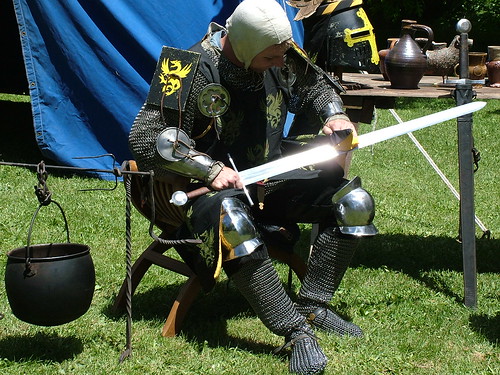
 Image: Rod Walker preparing for a modern formal deed of arms.
Usually such papers are not published without being extensively rewritten and (usually) expanded. And in fact readers who own my book Deeds of Arms will have seen most of these ideas. But for those whose interest in the topic is more casual, or who are just making some initial explorations of such subjects as 14th century chivalry, these papers may be of some use.
Conference Papers on Formal Deeds of Arms
We May Lose More Than We May Gain: Boldness and prudence among Froissart's warriors
Chivalric Deeds of Arms as Politics: Courtenay, Trémoille and Clary
The Moral Calculations behind Medieval Deeds of Arms
Non-noble deeds of arms in the Late Middle Ages
I hope you enjoy them!
Monday, February 28, 2011
Israel's Security: Then and Now -- Tuesday March 1
From Dr. Robin Gendron:
This is just a reminder that on Tuesday, March 1st the Nipissing Branch of the Canadian International Council will be holding a discussion of “Israel’s Security: Then and Now.” Our guest, Dr. David Tal, will compare the threats to its security that Israel faced at its founding 60 years ago with the security situation that it faces in the contemporary Middle East where, unlike in the 1950s, more and more states in the region accept Israel's existence and maintain either peaceful or actual relations with it. Militarily, the nature of the challenges facing Israel has changed too: conventional wars involving tanks and mass armies are less likely to occur than one involving missiles, air strikes, and attacks on civil population and centers. Israel will have to find ways to deter and retaliate against non-state threats without using the kind of force it has used in the past.
The event takes place on Tuesday March 1, starting at 7:00 pm in room F210 (the Fedeli Business Centre). This event is free and open to the public, and everyone is welcome! Please tell your students in particular. For more information about this event, please contact Robin Gendron at gendronrs@nipissingu.ca or 705-474-3450 ext 4395.
Monday, February 14, 2011
CIC-Nipissing: Afghanistan and Beyond
The Nipissing Branch of the Canadian International Council is pleased to announce that on February 17th it will be holding “An Evening with Master Corporal Mike Trauner: Afghanistan and Beyond.” Our guest, MCpl Mike Trauner, will speak about his experiences serving with the Canadian Armed Forces in Afghanistan as well as his recovery from the serious wounds he received while there.
The event takes place on Thursday February 17, starting at 6:30 pm in room F210 (the Fedeli Business Centre) at Nipissing University.
MCpl Trauner has served 13 years with the infantry. He lost both his legs and partial use of one arm after stepping on an Improvised Explosive Device (IED) in Afghanistan. He recently received the "To the Top Canada" award due to his determination to live a normal life, the example he presents to others and his drive to help others. He also raised the Paralympic international flag in Vancouver at the 2010 Winter Olympics. His presentation will be less formal as he generally speaks candidly and from the heart about his experiences. He will speak about his injury, the recovery process, what he misses from his past life, how he copes, successes, his interpretation of "Proud to be Canadian" and his future goals (politics).
This event is free and open to the public, and everyone is welcome!
Keep in mind as well that on Tuesday March 1st, the CIC-Nipissing will also welcome Dr. David Tal of the University of Calgary who will be discussing 'Israel's Security: Then and Now.'
For more information about either of these events, please contact Robin Gendron at gendronrs@nipissingu.ca or 705-474-3450 ext 4395.
Monday, February 7, 2011
This is what it costs
New York Magazine:
The Prozac, Paxil, Zoloft, Wellbutrin, Celexa, Effexor, Valium, Klonopin, Ativan, Restoril, Xanax, Adderall, Ritalin, Haldol, Risperdal, Seroquel, Ambien, Lunesta, Elavil, Trazodone War
The first time I meet David Booth, a 39-year-old former medic and surgeon’s assistant who retired this past spring after nineteen years in the active Army Reserve, I make the awkward mistake of proposing we go out to lunch. It seems a natural suggestion. The weather is still warm, and he has told me to meet him in the lobby of his office downtown, so I assume he wants to go out, not back to his desk, when I show up around noon. But it turns out that in the six months he has been at his job, Booth has never left his office in the middle of the day, except to run across the street, and he is simply too polite to say so. From the moment we step outside, it’s clear how unusual this excursion is for him. As we walk, he hews close to the buildings on his right (“If a building’s to my right, no one is going to walk by me on my right”), and when we arrive at the restaurant, he quietly takes a seat at the table closest to the door, his back against the wall. His large brown eyes immediately start darting around.
“How’s your sleep?” I ask him.
“I don’t,” he answers.
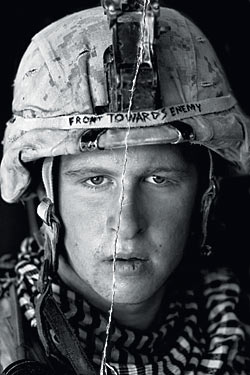
Image: A portrait by Louis Palu.
Friday, January 28, 2011
A valet who didn't play by the rules
My research on deeds of arms and the law of arms has tended to emphasize that legitimate war was supposed to be the monopoly of "men at arms," i.e. gentlemen, squires, knights and lords of higher rank, the kind of people who had adequate horses and armor. A scenario written by Geoffroi de Charny around 1350 certainly implies that a lesser man should not be able to capture a gentleman/man at arms for ransom. But did these theoretical strictures really constrain battlefield behavior?
 Here's a passage that Will McLean has taken from Froissart that suggests otherwise:
I wonder if Guillonet showed up at Lourde?
Image: part of the war band, but not men at arms.

They fought hand to hand, and Ernauton de Sainte Colombe, an excellent man at arms, was on the point of being killed by a squire of the country called Guillonet de Salenges, who had pushed him so hard that he was quite out of breath, when I will tell you what happened: Ernauton de Sainte Colombe had a servant (un varlet) who was a spectator of the battle, neither attacking nor attacked by any one; but, seeing his master thus distressed, he ran to him, and, wresting the battle-axe from his hands, said, 'Ernauton, go and sit down: recover yourself: you cannot longer continue the battle.' With this battle-axe he advanced upon the squire, and gave him such a blow on the helmet as made him stagger and almost fall down. Guillonet, smarting from the blow, was very wroth, and made for the servant to strike him with his axe on the head; but the varlet avoided it, and grappling with the squire, who was much fatigued, turned him round, and flung him to the ground under him, when he said, 'I will put you to death, if you do not surrender yourself to my master.' 'And who is thy master?' 'Ernauton de Sainte Colombe, with whom you have been so long engaged.' The squire, finding he had not the advantage, being under the servant, who had his dagger ready to strike, surrendered on condition to deliver himself prisoner within fifteen days, at the castle of Lourde, whether rescued or not. Of such service was this servant to his master; and, I must say, sir John, that there was a superabundance of feats of arms that day performed, and many companions were sworn to surrender themselves at Tarbes and at Lourde.
I wonder if Guillonet showed up at Lourde?
Image: part of the war band, but not men at arms.
Friday, December 31, 2010
For HIST 3805 students -- the Middle East and US policy at New Year 2011
Two informed summaries.
From the Economist, America and the Middle East:
Issander el-Amrani at the National (United Arab Emirates):
From the Economist, America and the Middle East:
Several reasons lie behind America’s loss of potency. Some reflect changes within the Middle East. Allies such as Israel and Turkey long followed American wishes reflexively because they felt imperilled and dependent on American largesse. They have now grown too strong for that. With its thriving economy, Israel feels able to take a more independent line. Turkey has also become an economic power and its government, unlike the dictatorships elsewhere in the Middle East, is now democratic. And although the region’s two strongest states still pursue policies that dovetail with America’s, they have grown unhelpfully estranged from each other.
Other allies that once augmented American power by proxy have grown too weak to help. Oil-rich Saudi Arabia packs financial clout, but its ruling princes are ageing and absorbed by a struggle for succession. Egypt, the most populous and diplomatically agile Arab country, is also run by old men. Once they could rally Arabs behind American objectives, but the Egyptians have struggled lately even to get the two main Palestinian factions, Hamas and Fatah, to talk to each other. The Mubaraks and the Al Sauds have little impact any more on the Arab Street: “resistance” and defiance carry more appeal. “The sense of how weak we are is a factor of how weak our partners are,” says Scott Carpenter, a Bush-administration official now with the Washington Institute for Near East Policy.
Fingers burned
America’s own mistakes, tactical and strategic, have speeded its decline. The failure to find banned weapons in Saddam’s Iraq and the torture at Guantánamo and Abu Ghraib have tainted America’s moral authority. The application of American firepower has, ironically, also raised the bar for defying America’s will. Iran and its allies, including Syria, Hamas and Hizbullah, the Lebanese Shia party-cum-militia, feel they can call America’s bluff because they think that, having burned its fingers in Iraq and Afghanistan, it will no longer back harsh words with invasions.
You can see how they might reach that judgment. Aside from nearly 6,000 American fatalities in Iraq and Afghanistan, the expenditure, so far, of more than $1.1 trillion on military operations in those theatres has sapped the will for more campaigns. The cost of keeping a single soldier on the ground now exceeds $500,000 a year—a strong reason for a poorer America to reduce its presence in the region.
The incoming, Tea-Party-infused Congress is likely to make things harder. Whereas rivalry between Democrats and Republicans used to end at the water’s edge, it now extends into foreign policy. Despite the ratification of the New START treaty at the end of 2010, Congress is beset by partisanship, even in petty matters. Solely because of partisan obstruction, Mr Obama has yet to secure approval for his choice of two career diplomats as ambassadors to Turkey and Syria.
America’s pro-Israel lobby shows no sign of losing strength. Jonathan Broder, foreign-affairs editor of the Congressional Quarterly, discerns an effort by Republicans to woo Jewish voters, long more supportive of Democrats, by outbidding the administration over Israel. Eric Cantor, the incoming House majority leader, has proposed moving the $3 billion annual military grant to Israel from the foreign-aid budget to the Pentagon, in effect shielding it from spending cuts. “Not only would this remove a lever for American pressure,” warns Mr Broder, “it would make us silent accomplices in the settlement process.”
However, other Washington observers lament that the lessons of failure in the Middle East have yet to be learned. “Obama said that we had not only to change the war in Iraq, but to change the mindset that led to the war, and this has not happened,” says Brian Katulis of the Centre for American Progress, a left-leaning Washington think-tank. Despite a view that soft power can be as potent as military muscle, he says, this has not translated into policy. Marc Lynch, of George Washington University, agrees: “The lesson we seem to have learned from Iraq is not, ‘Disaster, don’t do it again’, but rather, ‘Now we know how to do counterinsurgency.’”
Issander el-Amrani at the National (United Arab Emirates):
Yet, even so, there is no easy alternative to America's Middle Eastern dominion. As frustrated as they are with American policies, the WikiLeaks cables also show that the region's leaders ultimately depend on US leadership. No regional actor has the capacity to single-handedly shape the region, and despite a decline in its credibility and influence, Washington remains the indispensable actor. The question is now about its ability to deliver. The "new Middle East" that Barack Obama inherited from his predecessor has yet to take shape - its centre is congealed but not yet set - but increasingly appears to be directionless.
Washington's friends and enemies, therefore, look attentively for signals from an Obama administration midway through its first term, with enthusiasm about a less belligerent America having given way to worries about its dwindling influence. Major regional diplomatic powers that rely on their inclusion in American initiatives - Egypt's monopoly on talks with Hamas is the most flagrant example of this - worry that their own credibility will suffer from US setbacks. Gulf states that have effectively subcontracted their security to the US worry both about the risks of a regional confrontation with Iran and the weakened value of this external security guarantee. Iran, mired in domestic troubles, seeks regional prestige as Washington's challenger but its unnecessarily belligerent rhetoric reduces its margin of manoeuvre to honourably avoid a confrontation that could devastate it. Syria, disappointed by a lukewarm overture from the Obama administration as it tries to "flip" it away from Iran, plays hard to get, stretched in all directions by its multiple overlapping alliances.
Not unlike longtime junkies, the region's actors have developed a habit - an expectation that someone else will do the dirty work of managing a fractured Middle East, so they won't have to. After the heroin hit of Bush's creative destruction, they must do with the methadone of Obama. But they are still addicted to America.
Thursday, December 30, 2010
Rosie the Riveter and Geraldine Doyle

Subscribe to:
Posts (Atom)


