


This reviewer, writing for the online Medieval Review, also has a high opinion of it.
Fallows, Noel. Jousting in Medieval and Renaissance Iberia.
Woodbridge: Boydell and Brewer, 2010. Pp. xix, 541. $99.00. ISBN:
9781843835943.
Teofilo F. Ruiz
University of California, Los Angeles
tfruiz@history.ucla.edu
In this handsomely-produced and beautifully-illustrated book, Noel
Fallows offers, for the benefit of scholars and general readers alike,
four engaging, valuable, and interrelated contributions to our
understanding of jousting in late medieval and early modern Spain.
More importantly, the author, through a thoughtful deployment of texts
and images, takes us into the complex social and cultural world of
late medieval and early modern chivalry. Having just completed a book
on festive traditions (at the copy-editing stage presently), I can
only bemoan not having read this book earlier. And although I have
tried to incorporate many of Fallows' valuable insights and
information into my own work, his insights into these questions and
capacious treatment of the subject deserve more than just a passing
reference.
Anchored on the close reading of four seminal texts on jousting (plus
a series of other ancillary texts)--Pero Rodríguez de Lena's El
passo honroso de Suero de Quiñones (1434), Ponç de Menaguerra's
Lo cavaller (1493), Juan Quijada de Reayo's Doctrina del
arte de la caballería (1548), Luis Zapata de Chaves' "Del justador
(in his Miscelánea, 1589-93), plus short excerpts from Hernán
Chacón's Tractado de la cavallería de la gineta (1551)--Fallows
brings to life the chivalric world of jousting, connecting these texts
to their particular historical contexts. His four distinct and signal
contributions to the scholarship on jousting and other martial games
rest on his careful edition and translation of the above mentioned
works. His edition of the texts of Menaguerra, Quijada de Reayo,
Zapata de Chaves, and short excerpts from Chacón are the first modern
grouping of these works into one book. Although closely related to
each other thematically, they have never been examined as an almost
century and a half long discussion on jousting, warfare, and knightly
values. As such, his editions of these texts--also translated into
English for the first time--allow us to trace changes over time in the
rules, character, and equipment employed in Spanish jousts and
elsewhere in the West in the transition from the Middle Ages to the
early modern period.
Moreover, his new edition of significant portions--the most salient
ones--of Rodríguez de Lena's El passo honroso (the ur-text of
jousting in the Iberian peninsula) offers, once again through his up-
to-date edition and translation, an important source for the study of
fictional warfare in late medieval and early modern Spain, and,
because of the international nature of jousting in this period in
general and of the passo honroso in particular, the rest of
western Europe. His edited and translated short excerpts of Chacón's
Tractado is similarly the first version in English of a very
significant treatise on Spanish equestrian skills.
Second, although the edition and translation of the texts are found in
the second part of the book--almost as a stand-alone monograph--the
introductory study, found in Part One of Jousting in Medieval and
Renaissance Iberia, expands on the textual evidence, offering to
the reader four diverse perspectives on Spanish chivalrous culture.
His introduction and chapter 1 provides a typology of knightly armed
encounters: mêlée tournaments, tournaments, jousts, and other such
martial games. The introduction also places Fallows' edition of the
texts within a judiciously drawn map of methodological and
historiographical approaches to the topic. His opinions are measured
and sound, dealing as he does with diverse and, often times,
contradictory interpretations. And he does this in a civil fashion,
assessing the worth of each approach, while presenting his own point
of view. Moreover, he allows the texts to guide us through these
discussions, and what can be better than his command of these primary
sources in guiding his readers to a new understanding of the evidence.
While noting the cultural importance of printing in the diffusion of
the new culture and technologies of jousting, Fallows, by deploying
Pedro Cátedra's ideas about "paper chivalry," Martín de Riquer and,
most famously, Huizinga's arguments about late medieval chivalry,
explores the links between literature and armed combat and the
circularity of writing about chivalrous deeds, fictional combat, and
the reality of lived lives. In chapter 1, Fallows turns to a careful
analysis of the three main treatises on jousting, examining how these
texts intersect with the authors' personal experiences, as well as the
different contexts from which they wrote. These brilliant mini-
biographies and case studies allow us to place the three main writers
of treatises on jousting within a long tradition of martial games,
warfare, and court life. For me in particular, the information on two
of these authors, Quijada de Reayo and Zapata de Chaves, and their
role at the great pageantry held at Binche in 1549 and at Philip II's
court is a most welcome revelation.
Although his introduction and chapter one are also in themselves a
small monograph, chapters 2 and 3 offer us a different and as equally
valuable contribution. These two chapters, erudite and technically
complex, discuss types of armor, helms, saddles, weapons, and every
other piece of equipment used by knights during jousts and
tournaments. Profusely illustrated, technically precise, and with a
myriad of examples and images from the sources, they are a veritable
mine of information and a source for tracing the evolution of armor
and other equipment associated with these martial games from the late
fifteenth century into the sixteenth.
Chapters 4 and 5 shift the inquiry from armors and knightly equipment
to the nature of combat, its rules, and expectations. Fallows notes
the principles or ideals that governed the joust, how scores were
kept, excessive harm prevented, and wounds tended to. In chapter 6, he
turns his attention to war or, far more accurately, to the
relationship between jousting and actual warfare. Fallows, once again,
places his inquiry within the historiographical debate on whether
tournaments were a form of preparation for war or simply a form of
theater and display. Yet, his somber reflections on the actual carnage
found in sixteenth century warfare, the increasing toll taken by
firearms, and by the emphasis (for the sake of victory over the enemy)
on infantry and well disciplined formations over heroic single combat
clearly show the disconnect between the world of jousting and that of
the battlefield. Chapter 7 focuses on other forms of martial
spectacle, with the game of canes and the running of bulls featured
most prominently. These two semi-martial activities came to parallel
the medieval joust, marking a transition that the author describes as
"from sport to spectacle."
Early in his introduction Fallows notes that "chivalry must be seen in
order to be understood."(p. 27) This he has done as best as it could
be done by his vivid textual examples, case studies, and vivid
descriptions, creating a textual portrait of the joust. This he has
done superbly well by his choice of images and by the abundant amount
of visual material included in the book and keyed to the text. When
Spanish images have been lacking, he has borrowed from Italian,
German, French, and English visual evidence to provide us with a clear
idea of what was like to be in a joust. Technical at times, highly
engaging at most other times, this is a book that does many different
things, and it does all of them well. While examining the diverse
social and cultural aspects of fictitious and chivalrous warfare, the
texts that he has so carefully edited and translated remain a thread
that links the book's varied themes into a comprehensive and
compelling vision. I would have liked to see a more careful discussion
of the game of canes and of the role of bulls. I, for one, think that
they occupied an important place in the festive imaginary of early
modern Spain, but this is a very small quibble on what is an
impressive and important achievement. Fallows' super book, beyond
bringing these important treatises to the attention of scholars and
other readers, reintegrates Spain--often neglected in Huizinga's
masterpiece or in Roy Strong's discussions of festivals--into the
general late medieval and early modern European culture of jousting
and chivalric culture. That in itself is a worthy achievement.
Showing posts with label Middle Ages. Show all posts
Showing posts with label Middle Ages. Show all posts
Wednesday, July 27, 2011

Wednesday, July 20, 2011
Heavy armor
A BBC article on the weight of armor has got just about all my Facebook friends chattering.
Some of the professional historians think this is "pope is Catholic" junk science, and ask why in this time of disappearing funding for scholarly history, need this money be spent in this way? And were any historians consulted anyway?
Some of the reenactors are more interested, but the more informed -- the ones who have both worn armor and studied actual warfare -- ask whether this was a well-designed experiment.
I am both a professional scholar and someone who has worn armor (for 4 decades if you can believe it!) and I am not overly impressed -- tho I haven't seen the actual writeup behind the BBC article.
First, where are the horses? For much of the Middle Ages, it was the guys on horseback who were well-armed, and vice-versa.
Second, I say to the people who emphasize the drawbacks of armor what I say to those who are skeptical about the usefulness of heavy cavalry. Why did rich and important people buy expensive armor and wear it? and why did people who organized and paid for armies pay extra to well-armed men?
Third, full armor did have drawbacks and went out of use fairly quickly after it hit its peak of development. But the situation is not a binary one of full armor/no armor. Let's have a little more subtle analysis here.
Wednesday, July 6, 2011
The churches of York
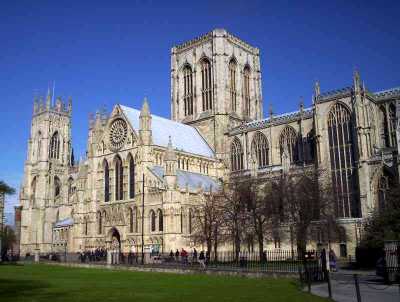
The last time I was in York it was 1972. The town, with its medieval walls and street layout, overpowered me. I was particularly impressed by the cathedral, York Minster, the biggest piece of medieval architecture I had seen yet. But as a budding medieval historian I was seriously taken with the number of other medieval churches there were in the immediate vicinity. It spoke to me of the tangible presence of the church in the city which was the capital of the north. I mused on the revolt against that presence during the Reformation (in an unsophisticated way).
This time what strikes my eye is how the people of York kept doing it -- building churches in medieval style in the vicinity of the Minster and those other real medieval churches. There are an awful lot of churches from, say, the last two centuries crowding into the Minster neighborhood, demanding attention.
Image: the Minster, from which a "clerk in holy orders" told me you can see a distant brewery tower. Ask me in person.
Thursday, June 9, 2011
Walking in Catalonia with Jonathan Jarrett
A Corner of Tenth-Century Europe is a valuable blog in many ways, but it really shines when Jonathan goes to visit the landscape that gave rise to his charters. He's doing it now! Don't miss it!

Saturday, June 4, 2011
Rethinking the Crusade environment in the light of the Arab Spring

(And the other thing that stuck with me from recent reading about Syria is the fear and loathing that so many have for the idea of an Islamic Republic; as logically follows.)
Well, I knew about many of these internal religious divisions, but hearing people discussing it NOW, and urgently, has made a big impact on my effective understanding of the "Muslim Middle East," to wit, I now think a lot, in the front of my mind about the fact that however important Islam has been in the Middle East since the 7th century, and however sweeping the claims various Muslims have made, and whatever wishes for an Islamic society have been wished, it's always been at least this divided. The divisions haven't always been active, but like so many fault lines in an earthquake-prone region, they've been there.
Think about the religious history of the United States, as another instance. So many people think it can or should be summed up in a phrase. How wrong they are.
So what does this have to do with the Crusade era, which I will again be teaching in the fall? I will have to think about something that Christopher Tyerman has said in a couple of places -- that the rulers and political and military actors "on both sides" were immigrants or recent descendants of such. And if religious justifications for their actions and regimes were important (if not always appealed to), it is just wrong, wrong, wrong to attempt to explain the developments of the era merely by casting it as two religiously homogenous societies battling it out. Even if that was the way some contemporaries, and influential ones at that, visualized reality.
It will be a challenge to strike the right balance.
Image: The Assad family, late 20th century -- Syria's most famous Alawis, a term you should look up.
Wednesday, June 1, 2011
Another $100 book
To be honest, I doubt I will be buying this book, but I think some readers of this blog will be interested in this review from The Medieval Review:
Bryant, Nigel, trans. Perceforest: The Prehistory of King Arthur's
Britain. Series: Arthurian Studies, 77. Cambridge: D.S. Brewer,
2011. Pp. xxiii, 791. $99.00. ISBN: 9781843842620.
Reviewed by Dorsey Armstrong
Purdue University
darmstrong@purdue.edu
Although it has started to receive greater critical notice of late,
the 14th-century text known as the Perceforest has received an
amount of scholarly attention that seems inversely related to its
significance. In other words, for a text that is so important on so
many different levels--narrative progression, social commentary,
synthesis and adaption of sources, expressions of social and courtly
ideals, religion, depiction of the magical and fantastic--the text has
not been examined with nearly the critical scrutiny it deserves, nor
has it become a part of the pedagogical "canon" of medieval romance
texts in the way its contents would suggest is appropriate. The
reason for this is clear: it is a massive work, filled with a series
of narrative adventures that are both thrilling (here, we have for
instance, the first known written account of the "Sleeping Beauty"
fairy tale) and overwhelming in their sheer number and repetition of
key themes and ideas. A critical edition in the original French is
currently being completed by Gilles Roussineau; this work began in
1987 and, so far, only four of the six sections have been completed--a
fact that speaks to the astonishing length and difficulty of this text.
The manuscript has rightly been referred to by at least one scholar as
"a veritable encyclopaedia of 14th-century chivalry" [1] and it is
truly encyclopedic in both its content and its sheer bulk. While its
comprehensive nature is one of the most fascinating things about the
Perceforest, it is also precisely this fact that has kept the
text out of the mainstream of academic investigation or from being a
subject for study in courses on medieval literature.
Thus, scholars and students owe Nigel Bryant a debt of gratitude, for
his new English translation (part of the Arthurian Studies series from
D.S. Brewer, of which Norris Lacy serves as general editor) makes the
Perceforest truly accessible for the first time to those
wishing to engage with its marvelous episodes. To be sure, the size
and weight of this edition is still a matter of some difficulty when
it comes to portability (the tome is a sturdy hardback, clocking in at
just over 800 pages) but Bryant has managed to squeeze into those many
pages all that is significant and important about the
Perceforest, its narrative threads, and its characters. To do
this, however, he has had to compress and abridge in some places; as
he himself says in the introduction to the volume: "In an ideal world,
this would be a complete translation, line by line, of the
extraordinary prehistory of Arthurian Britain that is
Perceforest...Realistically, a complete translation is not a
publishable proposition, or at least not a purchasable one" (1).
Bryant notes that he considered but then discarded the idea of simply
translating and publishing those episodes that have been deemed "key"
by those scholars working on the text, but points out (rightly) that
to do so would obscure and flatten much of what makes this text so
engaging: the narrative threads that cross and re-cross, the
appearance of fascinating characters who may only appear briefly, the
development of themes and ideas over a very long narrative progression.
So Bryant has opted for a more satisfactory if still less-than-ideal
solution: he gives us the whole text without omitting a single
character or episode, but some of these are compressed or summarized.
In order to distinguish between moments that are abbreviated from the
source text, Bryant explains that he has opted to use single quotation
marks "to indicate phrases and passages which are translated verbatim"
(31 n.1). This strategy is a clever way to make sure that the reader
is always clear as to which portions are summaries and which attempt
to render faithfully the source text.
The translation itself is accurate and lively, making it easy to
become absorbed in the narrative whether or not one has a background
in Old French or even medieval romance. Indeed, it is a work that
invites both casual perusal--an episode here, an adventure there--and
a careful sequential reading in order to yield all its treasures. As
Jane H.M. Taylor has observed of the Perceforest: "It is a
measure of the writer's remarkable success that the reader's
sympathies engage with the heroes and heroines, and that we arrive at
the end of the sixth book breathless perhaps, but neither lost nor
bored." [2]
The text is made easy to navigate by a comprehensive table of contents
that breaks the work down by books and chapters with detailed
descriptive titles conveying the main action of the narrative episodes.
Even more useful is Bryant's Introduction, the general style of which
is chatty and draws parallels between the events depicted in the
Perceforest and the kind of story-telling that seems appealing
to a 21st-century audience. Besides its very accessible tone, the
Introduction also demonstrates the translator's deep understanding of
the text: Bryant discusses such thematic elements of the text as
"Action and Entertainment"; "Chivalry"; "Women"; "Fragility, Fortune
and the Creator"; "Love"; "The 'New Law,' Morality, Secularism and
Magic"; and "Blood and Conflict." Each of these sections of the
Introduction functions as a kind of "mini-essay"-- complete with
footnotes and analysis of key passages--thus providing a vue
d'ensemble of the text as a whole from a variety of positions or
interests. The result is that before even beginning to tackle the
text proper, the reader has a clear sense of what the major themes and
ideals are, where in time the text begins and how it moves forward.
One even has a sense of the style and interests of the medieval author,
as much as that can be conveyed in a translation and short discussion.
What the Introduction does best is to provide the reader with a series
of "orientation points" as (s)he begins the journey through the
narrative--Bryant does an admirable job helping to keep us from
getting lost in the Perceforest's "forests of adventure" by
offering a series of "hooks" that can help one focus and avoid
becoming overwhelmed by the sheer number of narrative threads,
characters, and themes. Bryant offers us a place to start, and
readers then have a helpful foundation from which to begin their own
investigations of the Perceforest. The critical apparatus is
rounded out with a short list of important scholarly works on the text
and it identifies the medieval manuscripts in which it is to be found.
Nigel Bryant's translation of the Perceforest is engaging for
the student, helpful for the scholar, and promises to make this very
important work accessible to a much larger population than has
heretofore been the case. This can only be to the good, as with more
interest in and appreciation of this very important text, our
understanding of the fourteenth century and matters of class, culture,
literary genre, and social ideals is greatly enhanced and deepened.
One can also imagine the possibility of using this text--or large
sections of it--in the classroom, something previously difficult or
impossible. Nigel Bryant deserves our thanks, appreciation, and
admiration.
--------
Notes:
1. Jacques Barchilon, "L’histoire de la Belle au bois dormant
dans le Perceforest," Fabula 31.1-2 (1990): 17-23.
2. Jane H.M. Taylor, "Perceforest," in The New Arthurian
Encyclopedia, ed. Norris J. Lacy (New York and London: Garland
Publishing, 1996), 355-356.
Tuesday, May 31, 2011
Those belligerent jousters
In my own research on jousting which is based on Charny's questions on the law of arms as it applies to jousting tournaments and war, I got the impression that men at arms, full-fledged warriors, were a pretty argumentative lot. But of course, since Charny's questions are about resolving arguments, Charny had to conjure up some belligerent sorts, however many there may have been in real life. A few choice passages in Froissart's Chronicles convinced me that I was right about the belligerence, but I am pleased nonetheless to find in Noel Fallows' Jousting in Medieval and Renaissance Iberia proof positive that jousters were so concerned about their honor that they often got into arguments about the rules of the game and the rulings of the presiding judges.
One of the most interesting documents in Fallows' book is a very detailed account of a deed of arms that took place in 1434, El Passo Honroso de Suero Quinones. This deed, which involved ten jousters taking on all comers, was recorded blow-by-blow by a jouster, who not only gave a detailed account of each course, and explained which of the competitors did better, and why. I have my doubts that Froissart gave an accurate account in his famous description of St. Inglevert, but this account by Pero Rodriguez de Lena inspires confidence.
In the account it is quite common for there to be some accident that prevents two jousters from finishing the number of courses with broken spears set forth in the rules of the occasion, or some other event takes place that inspires one of the competitors to make a plea to the judges for a special dispensation – generally that they be allowed to ride some more courses on the field, perhaps at a later time. The judges, in this case two senior knights, absolutely refuse to change the rules or reverse their own decision once it has been made. To the demands of the competitors, the judges oppose the fact that all of the jousters have sworn to obey them in all matters. When the host of the event persists in defying them over a non-standard joust he wants to ride, they have him taken prisoner!
Yes, those old jousters were a willful lot, and those who presided over them had to push back hard.
One of the most interesting documents in Fallows' book is a very detailed account of a deed of arms that took place in 1434, El Passo Honroso de Suero Quinones. This deed, which involved ten jousters taking on all comers, was recorded blow-by-blow by a jouster, who not only gave a detailed account of each course, and explained which of the competitors did better, and why. I have my doubts that Froissart gave an accurate account in his famous description of St. Inglevert, but this account by Pero Rodriguez de Lena inspires confidence.
In the account it is quite common for there to be some accident that prevents two jousters from finishing the number of courses with broken spears set forth in the rules of the occasion, or some other event takes place that inspires one of the competitors to make a plea to the judges for a special dispensation – generally that they be allowed to ride some more courses on the field, perhaps at a later time. The judges, in this case two senior knights, absolutely refuse to change the rules or reverse their own decision once it has been made. To the demands of the competitors, the judges oppose the fact that all of the jousters have sworn to obey them in all matters. When the host of the event persists in defying them over a non-standard joust he wants to ride, they have him taken prisoner!
Yes, those old jousters were a willful lot, and those who presided over them had to push back hard.
Monday, May 30, 2011
A $100 book
Noel Fallows' Jousting in Medieval and Renaissance Iberia is a $100 book.
And I say that with the greatest respect.
I have been known to rant and rave about the fact that all too many scholarly works cost a hundred dollars. But every once in a while you come across something that bears that a price tag for a good reason, and this is one of them. I am very glad I got this book that a deep discount at an academic conference, but in all fairness I must say that Boydell Press can be proud of this publishing venture, and the price that they have attached to it is quite a reasonable one for the people who want the book.
And what a book it is. The phrase "antiquarian" comes to mind, because this seems to be an old-fashioned effort to collect and interpret all the relevant information on an important topic. Antiquarian is usually not a compliment these days, because antiquarianism is thought to emphasize collection over interpretation. There's just some subjects where nothing much can be done without collecting the source material first and making it available to the readers, who can then appreciate the scholar's interpretation. And this is the case with Fallows' book. English-speaking readers have little access to the rich material on jousting from Spain and Portugal in the later Middle Ages. So Fallows makes it available to us, so that we can we can explore the social and psychological and technical history of jousting in the Peninsula.
And no one could credibly say that Fallows is a deficient scholar, a "mere" antiquarian. It may be too much to say that he is scholarly Superman, but his big ambitions – to re-create before our eyes the entire world jousting – are matched by his energetic and careful compilation of data and sources.
Some of those sources are written accounts, including several manuals, about Iberian jousting. Their inclusion, which is immensely to the value of the book, makes this work a large one, over 500 pages. The book also includes a vast amount of information on the equipment used in jousting over the 14th 15th and 16th centuries. To aid the reader's understanding, there are dozens of photographs and other illustrations, printed on high-quality paper.
And now you know why this is a $100 book.
The intended reader of this book will not care about the price, if he or she can afford it up front. Once the reader has the book in hand, she or he will find hours and hours of edification and amusement. When I think of the real fans and the serious scholars immersing themselves in this amazing work, that's when I think of the antiquarian books of old, where an enthusiastic and often quite talented nonacademic scholar did his level best to master an exotic piece of the past, one that in his judgment had never been done justice before.
Gentlemen and ladies, you now know whether this book is for you.
I hope to say more about this book later.
And I say that with the greatest respect.
I have been known to rant and rave about the fact that all too many scholarly works cost a hundred dollars. But every once in a while you come across something that bears that a price tag for a good reason, and this is one of them. I am very glad I got this book that a deep discount at an academic conference, but in all fairness I must say that Boydell Press can be proud of this publishing venture, and the price that they have attached to it is quite a reasonable one for the people who want the book.
And what a book it is. The phrase "antiquarian" comes to mind, because this seems to be an old-fashioned effort to collect and interpret all the relevant information on an important topic. Antiquarian is usually not a compliment these days, because antiquarianism is thought to emphasize collection over interpretation. There's just some subjects where nothing much can be done without collecting the source material first and making it available to the readers, who can then appreciate the scholar's interpretation. And this is the case with Fallows' book. English-speaking readers have little access to the rich material on jousting from Spain and Portugal in the later Middle Ages. So Fallows makes it available to us, so that we can we can explore the social and psychological and technical history of jousting in the Peninsula.
And no one could credibly say that Fallows is a deficient scholar, a "mere" antiquarian. It may be too much to say that he is scholarly Superman, but his big ambitions – to re-create before our eyes the entire world jousting – are matched by his energetic and careful compilation of data and sources.
Some of those sources are written accounts, including several manuals, about Iberian jousting. Their inclusion, which is immensely to the value of the book, makes this work a large one, over 500 pages. The book also includes a vast amount of information on the equipment used in jousting over the 14th 15th and 16th centuries. To aid the reader's understanding, there are dozens of photographs and other illustrations, printed on high-quality paper.
And now you know why this is a $100 book.
The intended reader of this book will not care about the price, if he or she can afford it up front. Once the reader has the book in hand, she or he will find hours and hours of edification and amusement. When I think of the real fans and the serious scholars immersing themselves in this amazing work, that's when I think of the antiquarian books of old, where an enthusiastic and often quite talented nonacademic scholar did his level best to master an exotic piece of the past, one that in his judgment had never been done justice before.
Gentlemen and ladies, you now know whether this book is for you.
I hope to say more about this book later.
Saturday, May 28, 2011
The quest for answers to Charny's Questions
I have just posted the current draft of my translation of Geoffroi de Charny’s Questions concerning the joust, tournaments, and war. It is in the form of a blog entitled Charny’s Questions and it is located at http://charnyqs.blogspot.com/.
I have made the questions available in hopes that other scholars will know of parallels to individual questions or even solutions to some of the legal problems raised by Charny. Indeed, I have found or been sent a few already, and will be putting them in the comment section of the appropriate question. If you have something relevant, please do likewise.
I must say that I am only interested in material that originates in primary sources or in a detailed discussion in secondary treatments (few and far between!). I learned a long time ago that it is quite easy to come up with a plausible answer to most of these questions, indeed more than one. As Charny said repeatedly, “there are many good reasons offered on either side.” It’s a fun game to spin your own answers, especially around a campfire at a medieval re-creation, drink in hand, but that’s not what the blog is for.
Anyone is welcome to read the translation -- which, I warn you, is not quite done and has a few irresolvable problems -- but it is copyrighted. Please do not publish; if you are a scholar you might even hesitate to quote what is still a working document.
I should end this by thanking the various people who have helped with the most intractable problems of translation. I am very grateful, and you will all be thanked by name when I publish the final version.
Thursday, May 19, 2011
That beautiful destrier


In Charny's Questions on Tournaments, there is a case proposed to Charny's audience about a knight who brings a beautiful destrier to a tournament and decides not to ride it. An unarmed man gets on the destrier and rides out past the lists and all over the field, until some other tourneyers drag him to the goal post, knock him off, and take the destrier as a prize. The knight who brought the destrier to the tourney objects. Who is right?
At least, that's how I (and some others) think the question should be interpreted. Grammatically the question is such a puzzle that it stops learned philologists and scholars of medieval French in their tracks, and leads them to propose desperate measures, for instance, that there are words missing, either from the edition or from the original text in the manuscripts. I can well believe they are right about this, but it leaves me in an awkward position to explain how I arrived at my published translation, when I do publish one. At least I will know that had I spent my life studying Old and Middle French, I'd be in much the same situation.
I am deeply grateful to all the people who wrinkled their skulls over this problem to help me out. Generosity still reigns in medieval studies.
Image: Not exactly the destrier visualized by Charny.
Sunday, May 1, 2011
Wednesday, April 20, 2011
Guy Halsall on the Staffordshire Hoard

The Hoard also speaks to the nature of warfare itself. In Warfare and Society I argued, against a common view which claims that sieges were the main means of deciding the outcome of warfare, that the period 450-900 was one when pitched battles were unusually common. I drew attention not just to the frequency with which battles are mentioned in narrative sources but also to the need to see warfare in a broader, socio-economic context. There were factors concerning social structure and the élite’s dependence upon the army and military affairs for its legitimacy that pushed towards more frequent battlefield confrontation. Moreover, highly-developed fortification is notably absent between the Roman Empire’s fragmentation and the ninth century; siege-warfare was not the elaborate science it would be later. This is not surprising. Settlements, other than monasteries perhaps, were not the foci for wealth that they would become. If loot and booty oiled the cogs of early medieval politics, which they did, though not to the extent that is often surmised, it was not going to be yielded through the seizure of sixth- to eighth-century towns.
The best way to make a significant profit from warfare was to defeat the enemy army in battle, because early medieval armies took their wealth with them. More and more the lesson is underlined that, particularly in the immediately post-imperial centuries, people wore their wealth, and that was nowhere truer than with warriors, except that they also rode theirs. The price of a warhorse remained fairly (if you’ll excuse the pun) stable at about 10 solidi across western Europe between 450 and 900. It’s difficult to know what that really meant, the solidus usually being a somewhat abstract unit of account; suffice it to say that people swapped reasonably sized parcels of land for horses. These were then given lavishly decorated harnesses, bits, bridles and saddles – some of this seems to be represented in the Hoard. This, it’s worth pointing out, was a hugely risky investment; horses die distressingly easily on campaign. Looting the average Anglo-Saxon village – as we currently understand it – was not going to recoup such a loss.
An early medieval warrior’s own accoutrements didn’t cost a year’s income from a whole village, as sometimes claimed, but they certainly didn’t come cheap. They were adorned and decorated as much as possible. The sometimes-seen notion that things like the Sutton Hoo helmet represent ‘parade armour’ is misconceived. The early medieval warrior was a frightening and imposing, a glittering and plumed figure. I don’t doubt that in their own way these were every bit the dangerous strutting dandies that were their descendants in the Hussar regiments of a millennium later. The Staffordshire Hoard’s items emphasise this; the almost casual gilding and ornamentation of just about every object or surface that could be so decorated. The Hoard fascinates, it intrigues, but it does not surprise me.
What is maybe more important, following my earlier numbers game, is just how much of the surplus from the agriculture of earlier Anglo-Saxon England was being – excuse the pun – ploughed into the dandification of warriors. When you think of that, the lack of impressive settlements, say, becomes easier to understand. It also confirms the wealth of Mercia. We ought not to be surprised about where the biggest find of Anglo-Saxon gold was located.
Battles were a huge risk – early medieval people knew that – but if you won the rewards were enormous. Taking an enemy army’s horses, let alone its weaponry and armour, would represent a major windfall.
Those who know my work on Charny's Questions may get a laugh from this early appearance of "who gets the horse?"
Image: Helmet cheek-piece from the Hoard.
Sunday, March 6, 2011
The real (?) Ulrich von Liechtenstein
Dr. Beachcombing propounds:

Image: Yes, that's him, according to the Manesse Codex.
Ulrich von Liechtenstein (obit 1278) was a standard thirteenth-century knight. He had castles (three of them). He fought – above all, in Eastern Germany. And he also dressed up as a woman and rode from Maestre (Venice) up to Vienna.
Yes, yes, Beachcombing stopped too when he first read this many years ago. But now he no longer even notices. This is what comes of spending half your life in the Middle Ages…
The root of Ulrich’s unlikely transvestism was courtly love. In his poetical ‘autobiography’ – a word Beachcombing will return to – Ulrich describes how he decided to undertake his quest as an act of homage to one lady, but also, by extension to all women. Indeed, his autobiographical work – ich comes up frequently – is entitled Frauendienst (Lady Service).
As Ulrich rode through the hinterland of hellish medieval Europe – spending half your life in the Middle Ages also makes Beachcombing all too honest about what kind of world theirs was – he challenged the knights he met to jousts and gave gifts to ladies.
By the end of his little jaunt Queen Venus (i.e. Ulrich in drag) had broken 307 spears, donated 271 rings and unhorsed four knights. Included among his honoured opponents was a knight dressed as a monk that Beachcombing will let go without any comments. But also interestingly another knight dressed as a woman. How Beachcombing would have liked to have seen that joust. [There's more...]Me, too.

Image: Yes, that's him, according to the Manesse Codex.
Friday, March 4, 2011
Some conference papers on formal deeds of arms
Much of my scholarly efforts over the past decade has been analyzing formal deeds of arms in the later Middle Ages. These efforts, as is usual in academia, have generated a certain number of conference papers.
Usually such papers are not published without being extensively rewritten and (usually) expanded. And in fact readers who own my book Deeds of Arms will have seen most of these ideas. But for those whose interest in the topic is more casual, or who are just making some initial explorations of such subjects as 14th century chivalry, these papers may be of some use.
Conference Papers on Formal Deeds of Arms
We May Lose More Than We May Gain: Boldness and prudence among Froissart's warriors
Chivalric Deeds of Arms as Politics: Courtenay, Trémoille and Clary
The Moral Calculations behind Medieval Deeds of Arms
Non-noble deeds of arms in the Late Middle Ages
I hope you enjoy them!
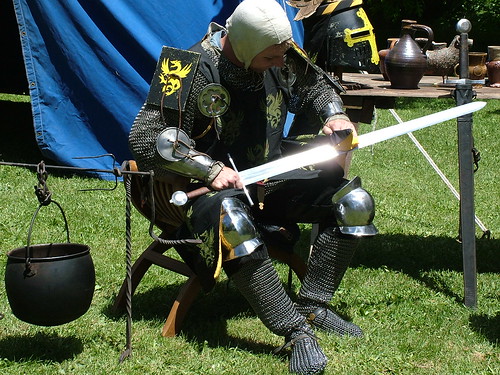
 Image: Rod Walker preparing for a modern formal deed of arms.
Usually such papers are not published without being extensively rewritten and (usually) expanded. And in fact readers who own my book Deeds of Arms will have seen most of these ideas. But for those whose interest in the topic is more casual, or who are just making some initial explorations of such subjects as 14th century chivalry, these papers may be of some use.
Conference Papers on Formal Deeds of Arms
We May Lose More Than We May Gain: Boldness and prudence among Froissart's warriors
Chivalric Deeds of Arms as Politics: Courtenay, Trémoille and Clary
The Moral Calculations behind Medieval Deeds of Arms
Non-noble deeds of arms in the Late Middle Ages
I hope you enjoy them!
Wednesday, February 16, 2011
Cheese, Pears and History in a Proverb

Montanari, Massimo. Cheese, Pears, and History in a Proverb.
New York: Columbia University Press, 2010. Pp. 128. $26.50/£18.50.
ISBN: 978-0-231-15250-1.
Reviewed by Paul Freedman
Yale University
paul.freedman@yale.edu
Even in an age of narcissism and first-person journalism it isn't
customary for reviewers of scholarly literature to put themselves
forward before getting around to reviewing the book at hand.
Nevertheless I feel compelled to say at the outset that this short
study (90 pages plus bibliographic references), for all that its
subject is completely new to me, encapsulates almost uncannily my own
interests over the last few years as it concerns gastronomy
(especially its social symbolism), seigneurial representations of the
peasantry (along with some attention to peasant opinions of their
masters as well), and the peculiar power and durability of proverbs.
Montanari starts out as if he is going to offer a micro-history of one
somewhat puzzling maxim, but the book turns into something
considerably more complex as it describes the reversibility and
circularity of our perceptions and articulations of reality.
Along with the late Jean-Louis Flandrin, Massimo Montanari has been a
pioneer in the study of medieval as well as modern cuisine. He has
discussed changing fashions in food and how these tastes were shaped
by considerations of social distinction. Food conveyed social claims
and status in the Middle Ages and this remains true now even if the
specific items have taken on new symbolic meanings. One era's fish
waste might be another's caviar; organ meats and root vegetables are
suddenly chic after decades of lowliness.
We begin with an old but still current Italian aphorism: "Do not let
the peasant know how good cheese is with pears". The ensuing
investigation analyzes this bit of advice whose actual meaning is not
at all clear, despite the widespread popularity of the saying
throughout Italy and similar formulations elsewhere in Europe.
Proverbs are usually supposed to be distillations of folk or lower-
class wisdom. Sancho Panza is given to proverbial observations, so
much so that the usually oblivious Don Quixote curses him and asks for
sixty thousand devils to take him away along with his irritating
sayings. Sam Gamgee doesn't annoy Frodo to the same degree in Lord
of the Rings, although he makes frequent down-to-earth gnomic
observations, sometimes citing his father's authority for them. Yet
the humorous warning about cheese and the pears expresses contempt for
ordinary people voiced by a person of superior rank even if
historically its use was not limited to the privileged classes but
rather was always well-known to peasants.
The combination of pears and cheese is hardly counter-intuitive nor an
intrinsic mystery. As early as the thirteenth century a French saying
asserts that God never made such a blessed marriage (Onques Deus ne
fist tel mariage / Comme de poire et de fromage). Montanari notes
that in 2007, a town in Friuli famous for its cheese was twinned with
one in Emilia-Romagna noted for pears. The first introduction of an
anti-peasant aspect to this pairing comes in the late sixteenth
century: "May you never know, peasant, what it is to eat bread, cheese
and pears" (Non possa tu mai villano sapere / Cio ch'è mangiar
pane, cacio e pere).
However tasty pears and cheese are, setting them side-by-side is odd
for a proverb with explicit class implications because cheese was a
typical peasant food while pears were aristocratic delicacies.
Montanari devotes the first part of the book to the medieval attitudes
towards the two items. Cheese was avoided by the upper classes as a
crude and unhealthful peasant staple until the fifteenth century when
in Italy a fashion for dressing up simple dishes and hierarchical
ranking of certain cheeses as prestigious made cheese more common in
aristocratic entertaining. Noble consumption of cheese remained
distinct from peasant patterns since for the latter cheese was a main
ingredient of a meal while for the well-off, cheese and fruit
comprised a small course to close a meal.
Unlike cheese, pears were always considered desirable, as were all
tree fruit. They are, or at least seemed to be, particularly
delicate, easily bruised and spoiled and so prized for their
fragility. In fact, however, some varieties are tough enough to be
stored in winter, but these hardy fruit were avoided by those with
some choice in the matter. Pears were commonly gifts made between
nobles, so that for example the Gonzaga dukes of Mantua gave away
their own early-ripening precoce di Moglia pears to their
friends.
Different in social cachet, pears and cheese were nevertheless equal
objects of medical disapproval, cheese because of its heaviness and
supposed indigestibility (common to most peasant fare such as beans or
root vegetables), and pears because of their humorally cold nature
which endangered the stomach. Doctors reluctantly allowed the
consumption of cooked fruit while cheese also achieved a grudgingly
accorded medical respectability. Cheese came to be seen as variable
in its properties and so capable of being matched with different
personal temperaments as argued by Pantaleone da Confienza in his
late-fifteenth century Summa laticiniorum whose composition
marks the advance of cheese into elite consideration.
The turning point of Montanari's intricate book is the introduction of
the social differentiation of gastronomic taste. The notion of fixed,
class- appropriate foods is particularly important to the seigneurial
image of the lowly, even bestial rustic. It's not only that peasants
depend on porridge, dairy products or onions for their sustenance, but
that this is their "natural" fodder. Even when given the opportunity
to consume better fare they cannot tolerate refined food any more than
nobles can readily digest the crude provender of agricultural
laborers. There are many medieval stories about well-off peasants who
marry into the upper classes and cannot adapt themselves to the diet
appropriate to their new status. Montanari cites the example of the
wily Bertraldo, a successful rustic who met a bad end at court because
of the exquisite food he had to eat. Once he fell ill he begged the
doctors to bring him beans simmered with onions and turnips cooked
under ashes, but as they did not comply, he died. Other examples have
a happier ending as the upstart peasant's wasting indigestion is
suddenly relieved when he is provided with beans and peas with soaked
bread, or cheese, or leeks and onions.
Taste and social status are, in fact, malleable and shifting despite
the efforts of medieval anecdotes to present food preference as fixed
by nature and class. On a basic level it would seem that cheese is a
rustic staple while pears are an aristocratic fancy, but the ascent of
cheese to a position of gustatory prestige shows that reputations can
change. The real fear seems to have been that the more successful
peasants would be able not only to tolerate but enjoy things deemed
inappropriate to their rank. The proverb about the pears and cheese
expresses a common noble and urban dislike of peasants not so much in
their traditional rural squalor but as socially mobile and newly
enfranchised.
The proverb is a bit more complicated, however. It is not as if the
peasants didn't know what pears were, after all. Medieval and early
modern rustics were responsible not only for cheese-making but for
taking care of fruit trees as well. Pears were not like spices,
purchased as imported luxuries and so relatively (but by no means
completely) unavailable to the lower orders. Even if peasants had
somehow discovered that cloves were delicious, they could hardly have
done anything with this knowledge, while if they knew how felicitous
the matching of pears and cheese was, they would start stealing,
holding back or otherwise appropriating the pears in their custody.
There are still additional layers to this seemingly simple saying and
in a final section Montanari shows us something about the flexibility
of this maxim and indeed of all proverbial wisdom despite, or because
of the aphorisms' pithily authoritative statements of the way the
world is. It is not enough to find out the "origin" of a saying but
to see who says it, who can say it and with what polyvalent
overtones. If the peasants already know about pears and cheese, then
in their enunciation the proverb has a rather amusing set of meanings
that might range from the fatuousness of upper-class claims to special
knowledge to expressing the comic degradation of worldly wisdom too
widely disseminated (consider the fate of the modern American cliché
that the three most important price factors in real estate are
"location, location, location," which once counted as serious advice
but is now risible).
This brief summary of the ins and outs of Montanari's argument only
peels the skin off the proverbial pear. Cheese, Pears, and
History is a marvelous book whose brevity reveals twists and
surprises in its carefully reasoned observations and conclusions.
Image: Blue cheese, pears...and choclate! From Coffeeandvanilla.com.
Wednesday, January 26, 2011
A review of Deeds of Arms in The Medieval Review
Muhlberger, Steven. Deeds of Arms: Formal Combats in the Late
Fourteenth Century. Highland Village, Texas: The Chivalry
Bookshelf, 2005. Pp xiii, 247. ISBN: 1-891448-44-7.
Reviewed by Donald J. Kagay
Albany State University
dkagay1@netzero.net
Like it or not, one of the major factors in maintaining the importance
of medieval studies to the modern world has been the study of late-
medieval war and research concerning its honored but sometimes
uncontrollable child, chivalry. One of the unfortunate offshoots of
this popularity has been a basic misunderstanding of the medieval
martial ethic by those who unabashedly serve the code of creative
anachronism and by an ill-informed general public that looks on
medieval warfare as a mild game always conducted according to
gentlemanly rules. To offset these misconceptions that have more in
common with the theme park's view of history than any realistic
historical record, Steven Muhlberger sets out in this book to explain
the context of the organized combats that were firmly tied to the
realm of warfare, but eventually found a life of its own within the
orbit of the tournament. To carry out this ambitious project, he
struggles to demonstrate that these bloody exchanges existed within an
evolving code of chivalry that attempted to establish at least a
modicum of order for battlefield and jousting ground alike.
The focus of this work--the late-fourteenth century--is largely
directed toward the era of the Hundred Years War (1337-1453). It is
built on the extensive use of the primary sources of the period (many
of which have been translated into English in the last century). These
include the chronicles of Jean Froissart, Jean Le Bel, Gutierre Diaz
de Gomez, Christine de Pizan, and Thomas Walsingham as well as
document collections associated with great chivalric figures as Edward
the Black Prince, Geoffrey de Charny, and Jean II le Meingre
(Boucicaut the younger). Muhlberger's initial direction with the use
of these sources is to demonstrate that the deeds of arms were firmly
connected to the brutal realities of medieval warfare, but also
personified humanizing theories such as just war that the mediator of
medieval society, the Church, had itself attempted to impose on human
conflict. By a minute study of both individual and group combat
sparking into existence inside and outside organized military
campaigns, Muhlberger shows that such contests were every bit as
dangerous as the melée that inundated the battlefield. He also reviews
the quite meticulous rules set up for fairness and the maintenance of
personal honor that came into being for the regulation of such
combats. From his extensive reading of the sources, Muhlberger
concludes that the evolving codes of martial rules did not come from
the jousting arena, but sprang from the impromptu conflicts carried
out by small groups of combatants serving in campaigns of much larger
armies. From this ever-shifting environment came both the regulations
and the larger-than-life heroes who were judged by them.
Much of the remainder of Muhlbereger's book centers on how the
emerging "industry" of individual and group conflicts were carried out
between French, English, Spanish, and Flemish participants. He follows
in great detail the challenge, the conduct of the resulting fight, and
the means by which fair play was supposed to prevent such conflicts
from lapsing into vendettas pure and simple. The highlight of this
discussion is Muhlberger's meticulous review of the Combat of Thirty
Against Thirty, a conflict of French and British knights in Brittany
during 1351. This encounter occurring in a backwater of the Hundred
Years War seemed to stir the imagination of European authors for next
few decades who viewed the small skirmish as a halfway-house of sorts
between the bloodiest aspects of actual warfare and the humane rules
of the tournament. From his discussion of this crucially important
incident of group conflict, Muhlberger moves to trace the influence of
such fighting on fourteenth-century societies. With the great interest
that deeds of arms caused, the chivalric fighter and the painful duty
of honor he swore to uphold became a regular topos in chronicles and
romances down to the sixteenth century. This chivalric imprint on
late-medieval society shaped reality--at least among upper-class
circles--when kings tied tournaments to marriage celebrations and
other episodes of high-level negotiation. The most important of these
public combats occurred in 1390 at St. Inglevert near Calais when
three French knights challenged and bested all comers from the ranks
of the English invaders. Though originally a private enterprise, the
St. Inglevert jousts became a source of French pride and established
the model for "national tournaments" down to the sixteenth century.
These popular chivalric norms that eventually became anachronistic in
the face of European warfare increasingly marked by the use of
gunpowder weaponry provided lucrative careers both on the tournament
circuit and in royal service to many a fourteenth-century warrior.
Muhlberger discusses these super-stars in his last chapter.
In all of his chapters, Muhlberger follows the well-trod path of
chivalric authors led by Jean Froissart. The inclusion of large
passages from their works in English translation (a feat which
Muhlberger has already duplicated online) is helpful to the general
reader as well as to the military and social historians whose study
focuses on the later Middle Ages. Muhlberger's greatest contribution
in this work, however, is the skillful inclusion of the realm of
faits d'armes into a military spectrum that effectively
stretched from the tournament to the battlefield. In some ways, then,
Muhlberger deserves to be placed in the company of the greatest modern
expert on individual and group combat of the later Middle Ages, Sydney
Anglo.
Fourteenth Century. Highland Village, Texas: The Chivalry
Bookshelf, 2005. Pp xiii, 247. ISBN: 1-891448-44-7.
Reviewed by Donald J. Kagay
Albany State University
dkagay1@netzero.net
Like it or not, one of the major factors in maintaining the importance
of medieval studies to the modern world has been the study of late-
medieval war and research concerning its honored but sometimes
uncontrollable child, chivalry. One of the unfortunate offshoots of
this popularity has been a basic misunderstanding of the medieval
martial ethic by those who unabashedly serve the code of creative
anachronism and by an ill-informed general public that looks on
medieval warfare as a mild game always conducted according to
gentlemanly rules. To offset these misconceptions that have more in
common with the theme park's view of history than any realistic
historical record, Steven Muhlberger sets out in this book to explain
the context of the organized combats that were firmly tied to the
realm of warfare, but eventually found a life of its own within the
orbit of the tournament. To carry out this ambitious project, he
struggles to demonstrate that these bloody exchanges existed within an
evolving code of chivalry that attempted to establish at least a
modicum of order for battlefield and jousting ground alike.
The focus of this work--the late-fourteenth century--is largely
directed toward the era of the Hundred Years War (1337-1453). It is
built on the extensive use of the primary sources of the period (many
of which have been translated into English in the last century). These
include the chronicles of Jean Froissart, Jean Le Bel, Gutierre Diaz
de Gomez, Christine de Pizan, and Thomas Walsingham as well as
document collections associated with great chivalric figures as Edward
the Black Prince, Geoffrey de Charny, and Jean II le Meingre
(Boucicaut the younger). Muhlberger's initial direction with the use
of these sources is to demonstrate that the deeds of arms were firmly
connected to the brutal realities of medieval warfare, but also
personified humanizing theories such as just war that the mediator of
medieval society, the Church, had itself attempted to impose on human
conflict. By a minute study of both individual and group combat
sparking into existence inside and outside organized military
campaigns, Muhlberger shows that such contests were every bit as
dangerous as the melée that inundated the battlefield. He also reviews
the quite meticulous rules set up for fairness and the maintenance of
personal honor that came into being for the regulation of such
combats. From his extensive reading of the sources, Muhlberger
concludes that the evolving codes of martial rules did not come from
the jousting arena, but sprang from the impromptu conflicts carried
out by small groups of combatants serving in campaigns of much larger
armies. From this ever-shifting environment came both the regulations
and the larger-than-life heroes who were judged by them.
Much of the remainder of Muhlbereger's book centers on how the
emerging "industry" of individual and group conflicts were carried out
between French, English, Spanish, and Flemish participants. He follows
in great detail the challenge, the conduct of the resulting fight, and
the means by which fair play was supposed to prevent such conflicts
from lapsing into vendettas pure and simple. The highlight of this
discussion is Muhlberger's meticulous review of the Combat of Thirty
Against Thirty, a conflict of French and British knights in Brittany
during 1351. This encounter occurring in a backwater of the Hundred
Years War seemed to stir the imagination of European authors for next
few decades who viewed the small skirmish as a halfway-house of sorts
between the bloodiest aspects of actual warfare and the humane rules
of the tournament. From his discussion of this crucially important
incident of group conflict, Muhlberger moves to trace the influence of
such fighting on fourteenth-century societies. With the great interest
that deeds of arms caused, the chivalric fighter and the painful duty
of honor he swore to uphold became a regular topos in chronicles and
romances down to the sixteenth century. This chivalric imprint on
late-medieval society shaped reality--at least among upper-class
circles--when kings tied tournaments to marriage celebrations and
other episodes of high-level negotiation. The most important of these
public combats occurred in 1390 at St. Inglevert near Calais when
three French knights challenged and bested all comers from the ranks
of the English invaders. Though originally a private enterprise, the
St. Inglevert jousts became a source of French pride and established
the model for "national tournaments" down to the sixteenth century.
These popular chivalric norms that eventually became anachronistic in
the face of European warfare increasingly marked by the use of
gunpowder weaponry provided lucrative careers both on the tournament
circuit and in royal service to many a fourteenth-century warrior.
Muhlberger discusses these super-stars in his last chapter.
In all of his chapters, Muhlberger follows the well-trod path of
chivalric authors led by Jean Froissart. The inclusion of large
passages from their works in English translation (a feat which
Muhlberger has already duplicated online) is helpful to the general
reader as well as to the military and social historians whose study
focuses on the later Middle Ages. Muhlberger's greatest contribution
in this work, however, is the skillful inclusion of the realm of
faits d'armes into a military spectrum that effectively
stretched from the tournament to the battlefield. In some ways, then,
Muhlberger deserves to be placed in the company of the greatest modern
expert on individual and group combat of the later Middle Ages, Sydney
Anglo.
Tuesday, January 18, 2011
Christine de Pisan and formal deeds of arms

She wrote about them, just as she wrote about military reform. Will McLean directs us to her chivalric accounts.
Image: The Book of the Duke of True Lovers, at Google Books.
Monday, January 3, 2011

Sunday, December 26, 2010
Excerpt from the Abstract: Outrance and Plaisance

Abstract: Outrance and Plaisance (an excerpt)
Will McLean “Outrance and Plaisance” in Journal of Medieval Military History 8 (2010): 155-170The complete abstract is here.
Modern writers on medieval deeds of arms often use the term à outrance to describe combats fought “using the normal weapons of war” and à plaisance to describe combats using “specially modified weapons with sharp edges removed or blunted”.
However, during the 15th century, when the terms were most often used to describe contemporary deeds of arms, writers in Burgundy, France, Spain and England used the terms very differently. Sharp weapons of war and blunt weapons could be used in both sorts of combat. Instead, arms à outrance were distinguished by the willingness of the champions to fight until one side or the other was captured or killed, unless the judge or judges stopped the fight. This could happen either in the context of a judicial duel or a high stakes combat by mutual consent.
Arms à plaisance were less extreme, and would typically end as soon as an agreed number of blows were struck, or as soon as a combatant was carried to the ground.
The author quotes contemporary accounts of the extraordinary combats that 15th century writers described as à outrance. They show what happened in the rare cases when they were fought to the finish, as well as the less uncommon fights that were halted or proposed but not accepted. He also quotes 15th century accounts of a more limited combat à plaisance that was nonetheless fought with sharp weapons.
Combats à outrance were extraordinary events and their potential to end in legalized homicide presented the judges with a dilemma. Their response gives a measure of how extraordinary these combats were. In deciding whether and how far to allow deeds of arms to proceed under their control, rulers struck a delicate balance among competing goals: displaying their own power, fairness and authority, gratifying noble subjects, entertaining the populace and maintaining good order in their realm.
Image: some are still at it.
Saturday, December 18, 2010
Will McLean, "Outrance and Plaisance"
Will McLean has written an important article on "Outrance and Plaisance," two terms often misused to describe late medieval deeds of arms as "to the death" or "not." It appears in this year's volume of the Journal of Medieval Military History which is, alas, a bit pricey if you have to buy it yourself. Maybe Will will provide a short abstract at some point?
Subscribe to:
Posts (Atom)


